
Running a small business today means competing for attention in one of the most crowded spaces there is: social media. Every day, billions of people scroll through Facebook, Instagram, and TikTok — but simply having a business page there isn’t enough to get noticed. Platform algorithms are built to prioritize paid content, which means even businesses with loyal followers often reach only a small fraction of their audience organically. That’s where Social Media Advertising comes in.
Unlike traditional marketing methods such as print ads or billboards, social media advertising lets you put your brand directly in front of people most likely to buy from you — based on their location, interests, age, and online behavior. Done right, it turns a modest budget into measurable leads, website visits, and sales, rather than just “likes” and impressions.
In this guide, we’ll break down exactly what social media advertising involves, why it has become essential for small businesses trying to grow in a competitive market, the common mistakes businesses make without expert guidance, and what a professional social media advertising management service — like the one we offer at Next Brand IT — actually looks like from start to finish.
What Is Social Media Advertising?
Social media advertising for small business is the practice of paying platforms like Facebook, Instagram, TikTok, and LinkedIn to display your content to a specific, targeted audience — rather than relying on your existing followers to see and share your posts. Instead of hoping the right people stumble across your page, you’re actively placing your brand in front of potential customers based on data the platforms collect about their users’ interests, demographics, and behavior. This helps small businesses increase brand awareness, generate leads, and reach the right audience more effectively.
Organic vs. Paid Social Media
It helps to understand the difference between the two:
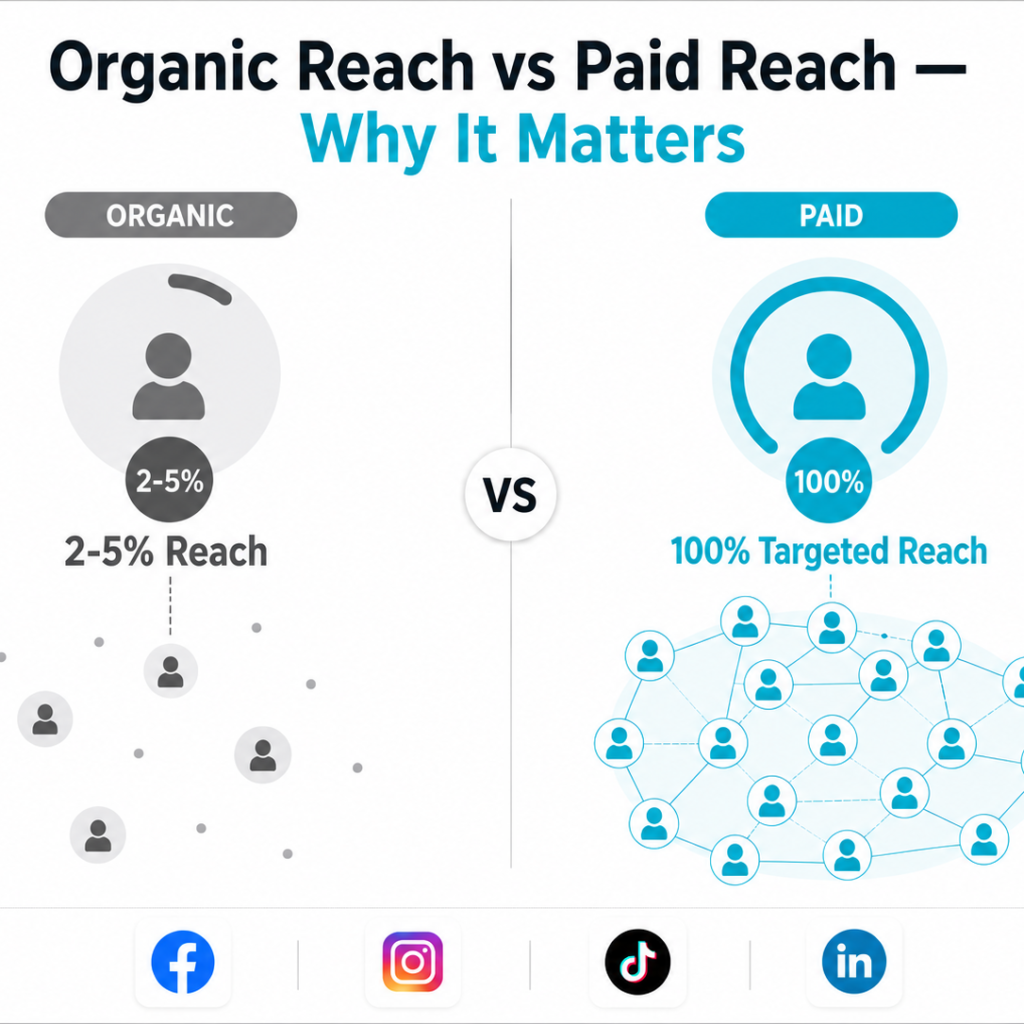
Organic social media is everything you post for free — updates, photos, videos, stories. It builds long-term brand identity and community, but its reach is limited. Platforms like Facebook now show organic business posts to a small percentage of followers, often under 5–10%, because their algorithms are designed to encourage businesses to pay for visibility.
Paid social media (advertising) guarantees your content is shown to a defined audience you choose, regardless of whether they follow you. You control who sees it, when, and how much you spend — and you get direct performance data in return: impressions, clicks, conversions, and cost per result.
Most successful small businesses use both together: organic content builds trust and brand voice, while paid ads drive discovery, traffic, and sales at scale.
The Main Platforms and Where They Fit
- Facebook — Still the largest ad platform globally; strong for local businesses, retargeting, and detailed audience targeting across age groups.
- Instagram — Visual-first; ideal for lifestyle brands, fashion, food, beauty, and e-commerce products that rely on strong imagery or video.
- TikTok — Fast-growing, especially effective for reaching younger audiences (Gen Z and younger millennials) with short-form, authentic video content.
- LinkedIn — Best suited for B2B businesses, professional services, and companies targeting decision-makers rather than general consumers.
Choosing the right platform (or combination) depends entirely on where your target customers actually spend their time — not on which platform is trending.
What a “Social Media Advertising Management Service” Actually Means
When an agency offers a Social Media Advertising Management Service, it means they take full ownership of your ad campaigns rather than just running a single boosted post. This typically includes strategy development, audience targeting, ad creative production, budget management, ongoing optimization, and performance reporting — essentially acting as your outsourced advertising department. For most small business owners, this matters because running effective ads requires continuous testing and platform expertise that’s difficult to maintain alongside actually running the business.
Why Social Media Advertising Matters for Small Businesses
For small businesses working with limited budgets and small teams, social media advertising isn’t just a “nice to have” anymore — it’s often the most efficient way to compete with bigger, better-funded competitors. Here’s why it matters, backed by current data.
1. Organic Reach Has Collapsed
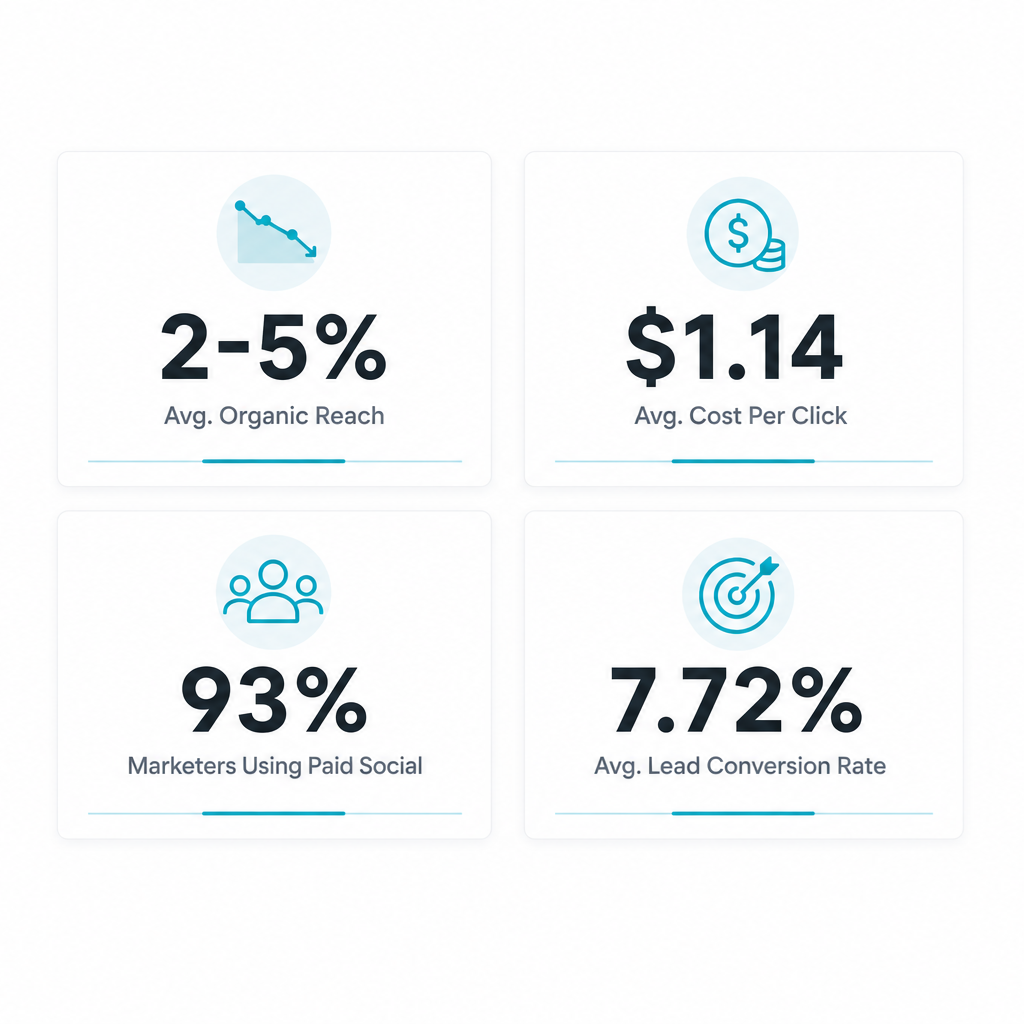
The numbers tell a clear story. Average organic reach for Facebook Pages has fallen to just 2–5% of total followers in 2026, down from over 15% back in 2014 — meaning a page with 10,000 followers can now expect only 200–500 people to see each unpaid post. Instagram tells a similar story, with average reach hovering around 7.6% of followers, and some 2024 measurements showing reach dropping as low as 4.0%, an 18% year-over-year decline. For a small business trying to build visibility, relying on organic posts alone is no longer a realistic growth strategy — it’s effectively invisible marketing.
2. Massive, Still-Growing Audience to Reach
The scale of the opportunity remains enormous. Meta’s family of apps reached 3.58 billion daily active people by the end of 2025, up 7% year-over-year, and Meta posted $56.31 billion in quarterly revenue in Q1 2026, up 33% year-over-year — the vast majority coming from advertising. Even within specific demographics, the audience is highly active: in the US, 80% of adults aged 30–49 use Facebook, and 58% of that group logs in daily, according to Pew Research Center. For small businesses, this means your customers are almost certainly already there — the question is whether you’re visible to them.
3. Cost-Effective, Even on Small Budgets
Contrary to the assumption that advertising requires deep pockets, platforms remain relatively affordable to test and scale. Average cost-per-click on Facebook ads sits around $1.14, and lead generation campaigns average a 7.72% conversion rate — with some industries performing far higher, such as Restaurants and Food at 18.25% and Legal Services at 10.53%. This means small businesses can start with a modest daily spend, measure results immediately, and scale only what’s proven to work — rather than committing to an expensive campaign upfront.
4. Real-Time, Measurable Data
Every dollar spent on social ads is trackable down to the click and the conversion — a level of transparency traditional marketing never offered. This data-driven feedback loop is exactly why over 10 million active advertisers now run campaigns on Facebook every month, with roughly 93% of marketers using the platform as part of their strategy. Businesses aren’t guessing anymore — they’re optimizing based on hard numbers, adjusting targeting, creative, and budget in real time.
5. Levels the Playing Field Against Bigger Competitors
Because platforms reward relevance and engagement rather than pure budget size, a well-targeted campaign from a small business can outperform a poorly targeted one from a much larger competitor. Smaller, focused pages often see stronger engagement per post than larger ones — meaning a well-run small business account genuinely has room to compete, once paid support is added on top of quality content.
6. Staying Visible Where Competitors Already Are
Conversion rates on Facebook ads vary significantly by industry, but the underlying pattern holds everywhere: businesses across virtually every sector are already running targeted campaigns to reach the same customers you are. Without an active presence, a business risks becoming invisible in its own market. Advertising has shifted from a growth tactic to a baseline requirement for staying visible at all.
Common Challenges Small Businesses Face Without Expert Help
Running social media ads yourself is easy to start but hard to do well. Most small business owners who try managing campaigns on their own eventually run into the same set of problems — often without realizing it until budget has already been wasted.
1. Poor Audience Targeting
Facebook and Instagram’s ad platforms offer dozens of targeting options — location, age, interests, behaviors, custom and lookalike audiences — but choosing the wrong combination is one of the most common (and expensive) mistakes. Targeting too broadly wastes budget on people unlikely to convert; targeting too narrowly limits reach and inflates costs. Without experience reading platform data, it’s difficult to know which levers actually move results.
2. Weak Creative and Messaging
An ad can be perfectly targeted and still fail if the creative doesn’t stop the scroll or the copy doesn’t clearly communicate value. Business owners often reuse product photos or generic text that works fine for organic posts but performs poorly as paid content, where competition for attention is far higher.
3. Underestimating Budget and Timeline
Many small businesses expect immediate results and pull campaigns after a few days of “no sales,” not realizing that platforms need time — often 1–2 weeks — to gather enough data to optimize delivery. Stopping and restarting campaigns repeatedly resets this learning process, wasting spend without ever reaching a stable, efficient result.
4. No Systematic Testing
Effective advertising relies on continuous A/B testing — of audiences, creatives, headlines, and placements — to find what actually works. Without a structured testing process, most self-managed campaigns run on guesswork, missing opportunities to lower costs or improve conversion rates significantly.
5. Time Constraints
Social media ad platforms update frequently — new ad formats, targeting restrictions, and algorithm changes roll out regularly. For a business owner already juggling operations, sales, and customer service, staying current with these changes while also managing daily campaign optimization is simply not realistic.
6. Difficulty Measuring True ROI
Tracking pixel setup, conversion events, and attribution requires technical know-how. Many small businesses run ads without properly configured tracking, meaning they can’t actually tell which campaigns are driving real sales versus which are just generating clicks — making it impossible to make informed decisions about where to spend next.
What a Social Media Advertising Management Service Actually Includes
A professional social media advertising management service isn’t a one-time setup — it’s an ongoing, structured process. Here’s what a proper agency workflow typically looks like, step by step.
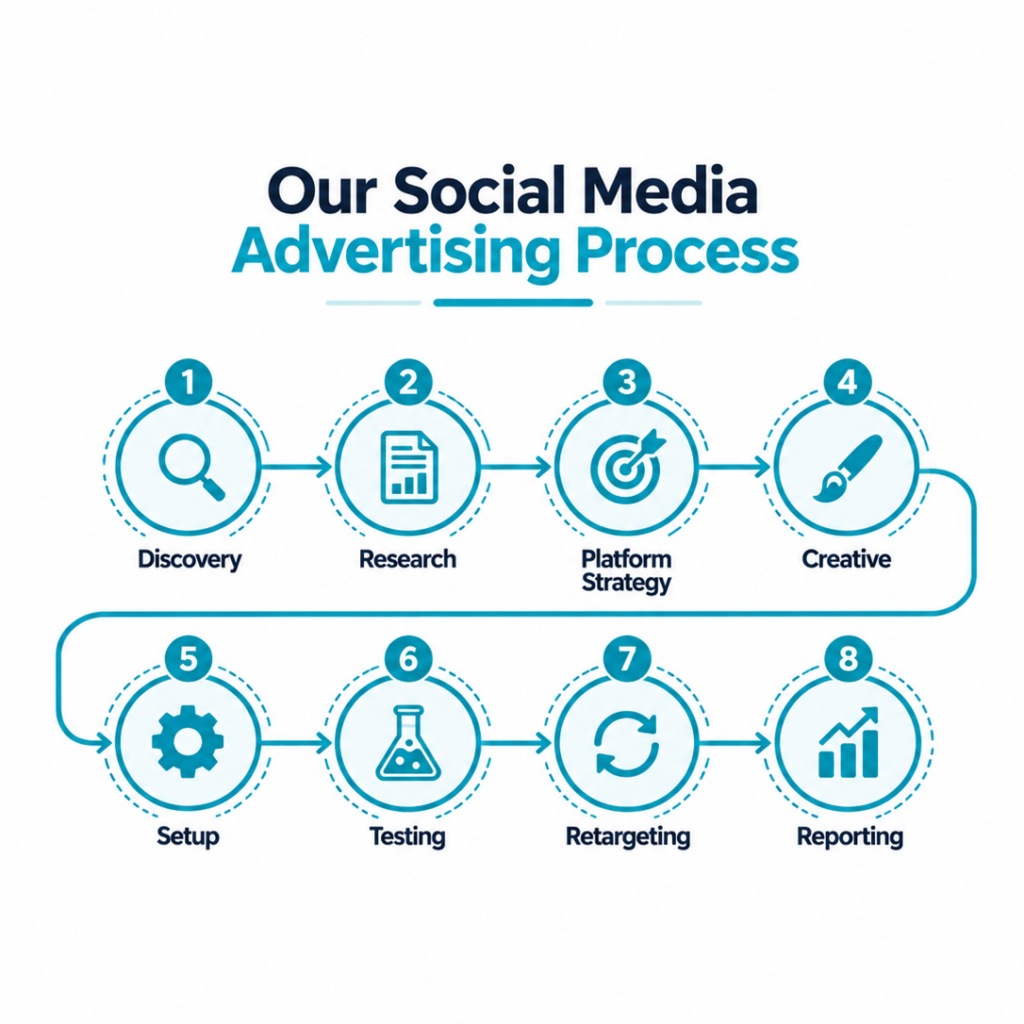
Step 1: Discovery & Goal Setting
Every effective campaign starts with clarity, not creative. The agency identifies your specific business objectives — whether that’s driving website traffic, generating leads, boosting online sales, or building brand awareness — and defines measurable KPIs as part of a clear digital marketing strategy. This step also includes understanding your social media marketing goals, budget range, and timeline expectations so the strategy is grounded in realistic outcomes rather than guesswork.
Step 2: Audience Research & Competitor Analysis
Before a single ad is built, the agency conducts thorough target audience research — studying demographics, interests, online behavior, and purchasing patterns — alongside a detailed competitor analysis of what similar businesses in your space are already running. This research shapes everything downstream, from platform selection to ad messaging.
Step 3: Platform Selection & Strategy
Not every platform suits every business. Based on where the target audience is most active, the agency builds a paid social media strategy covering Facebook, Instagram, TikTok, or LinkedIn — along with the right campaign objective (awareness, consideration, or conversion) for each as part of a broader social media marketing plan.
Step 4: Creative Development
This stage covers ad creative design, copywriting, and video production tailored specifically for paid placements rather than repurposed organic content. Strong social media content creation is tested in multiple variations — different images, headlines, and calls-to-action — to identify what resonates best.
Step 5: Campaign Setup & Budget Allocation
The agency handles technical ad budget management — audience parameters, bidding strategy, daily or lifetime budgets, ad scheduling — along with conversion tracking (such as the Meta Pixel or conversion API) and ongoing cost per click optimization to ensure every result is measurable from day one.
Step 6: Launch, Monitoring & A/B Testing
Once live, campaigns aren’t left unattended. The team runs structured A/B testing across creatives, audiences, and placements, combined with continuous campaign performance monitoring and ad optimization to identify what consistently performs best.
Step 7: Retargeting & Funnel Building
Beyond first-time visibility, the strategy includes retargeting campaigns aimed at people who’ve already engaged — website visitors, video viewers, past customers — using a remarketing strategy to move them further down the social media marketing funnel toward a purchase decision.
Step 8: Reporting & Ongoing Optimization
Finally, the agency delivers regular reports translating raw data into clear performance reporting — cost per lead, return on ad spend (ROAS), and conversion trends — measuring true social media ROI and using these findings to continuously refine targeting, budget, and creative direction.
What We Offer at Next Brand IT
At Next Brand IT, we operate as a full-service social media ads agency, taking complete ownership of your campaigns from strategy to reporting — so you don’t have to become an advertising expert to grow your business online. As a trusted digital marketing agency for small businesses, we understand that every dollar matters, and every campaign needs to justify its cost with real, measurable results.
Here’s exactly what’s included when you work with us:
Strategy & Audience Research
We start by understanding your business, your customers, and your competitors — building a data-informed targeting strategy before a single ad goes live. This ensures your budget reaches people who are genuinely likely to convert, not a broad, unqualified audience.
Ad Creative & Copywriting
Our in-house design and content team produces scroll-stopping visuals, video ads, and persuasive copy tailored specifically for paid placements — not repurposed organic posts. Every creative is built to perform, not just to look good.
Campaign Setup & Management
We handle the full technical setup across Facebook, Instagram, and TikTok Ads Manager — audience targeting, budget allocation, bidding strategy, and conversion tracking — configured correctly from day one to avoid wasted spend.
Budget Optimization
Rather than “set and forget,” we continuously test and refine campaigns — adjusting audiences, creatives, and bids based on real performance data to lower your cost per result over time.
Retargeting Campaigns
We build dedicated retargeting funnels for people who’ve already visited your website, engaged with your content, or added items to cart — turning warm interest into actual sales.
Monthly Reporting
You receive clear, jargon-free performance reports covering reach, cost per lead, conversions, and return on ad spend — so you always know exactly what your investment is producing.
Beyond Social Media Ads
As a complete digital marketing agency for small businesses, we also offer SEO, website customization, graphic design, video editing, and branding — meaning your entire digital presence can be managed under one roof, with every channel working together rather than in isolation.
Why Businesses Choose Next Brand IT
- Small-business-first approach — we build strategies around real budgets, not enterprise-level assumptions
- Results over vanity metrics — our focus stays on leads and sales, not just impressions and likes
- Transparent reporting — no hidden fees, no confusing jargon, just clear numbers
- Cross-industry experience — from local service businesses to e-commerce brands, we adapt strategy to what actually works in your category
Whether you’re launching your first campaign or looking to fix underperforming ads, our social media advertising management services are built to remove the guesswork and deliver consistent, measurable growth.
Who Should Use This Service
Social media advertising management works especially well for certain types of businesses — though the underlying strategy adapts to almost any industry. Here’s who tends to benefit most:
E-commerce & D2C Brands
Businesses selling products directly online rely heavily on visual platforms like Instagram and Facebook to showcase products, run retargeting campaigns for cart abandoners, and drive direct conversions — making paid social one of the highest-ROI channels available.
Local Service Businesses
Restaurants, salons, clinics, real estate agencies, and similar location-based businesses benefit from hyper-local targeting, reaching people within a specific radius who are actively searching for exactly what they offer.
Startups & New Brands
Businesses without an established customer base or brand recognition can use paid social to build awareness quickly, rather than waiting years for organic growth to compound.
Businesses Facing Increased Competition
Any business noticing competitors gaining visibility or market share online typically needs paid campaigns just to maintain parity — staying competitive rather than falling behind.
Businesses with Underperforming In-House Campaigns
Companies already running ads without dedicated expertise often see immediate improvement once a professional strategy, proper tracking, and structured testing are introduced.
In short — if your business depends on new customer acquisition, brand visibility, or measurable growth, social media advertising management is worth serious consideration.
FAQ:
1. Why do I need a Social Media Advertising Management Service instead of running ads myself?
Running ads without expertise often leads to wasted budget from poor targeting, weak creative, and premature campaign changes. A professional service brings structured testing, proper conversion tracking, and ongoing optimization — turning guesswork into a repeatable, data-driven process that consistently improves results over time.
2. How much budget do I need to get started as a small business?
There’s no fixed minimum — budgets depend on your industry, goals, and competition level. Many small businesses start with a modest daily spend to test what works, then scale gradually based on performance data rather than committing a large budget upfront without proof of results.
3. How long does it take to see results from social media ads?
Most campaigns need 1–2 weeks to gather enough data for the platform’s algorithm to optimize delivery effectively. Early performance often improves significantly after this initial learning phase, and consistent, compounding results typically develop over 60–90 days of ongoing optimization.
4. Which social media platforms should my business advertise on?
The right platform depends entirely on where your target audience spends time. Facebook and Instagram work well for most local and e-commerce businesses, TikTok suits brands targeting younger audiences, and LinkedIn is best for B2B and professional services. A management service typically tests and narrows this down based on real data.
5. How do I know if my social media ads are actually working?
Proper conversion tracking — such as a correctly configured pixel and defined conversion events — is essential to measure real outcomes like leads, sales, and cost per result, rather than relying on vanity metrics like likes or impressions. Regular reporting should clearly show return on ad spend (ROAS) tied directly to business goals.
6. What should I look for in a digital marketing agency for small business?
The right digital marketing agency for small business should offer transparent pricing, clear reporting tied to real business outcomes (not just impressions or likes), and a strategy tailored to your specific budget rather than a one-size-fits-all package. Look for an agency with experience across your industry, willingness to start small and scale based on results, and services that go beyond ads alone — such as SEO, branding, and website support — so your entire online presence works together rather than in silos.
Conclusion
Social media advertising has moved from being an optional extra to a core requirement for small business growth. With organic reach continuing to decline across every major platform, businesses that rely solely on unpaid posts are becoming increasingly invisible to the very customers they’re trying to reach. A well-managed paid strategy — built on precise targeting, strong creative, and continuous optimization — remains one of the most cost-effective ways for a small business to compete, even against much larger, better-funded competitors.
The difference between a wasted ad budget and a genuinely profitable campaign usually comes down to strategy, structure, and consistent testing — exactly what a dedicated social media advertising management service provides. Whether you’re launching your first campaign, trying to fix underperforming ads, or simply don’t have the time to manage it all yourself, working with an experienced team can turn social media from a guessing game into a reliable growth channel.
At Next Brand IT, we help small businesses — locally and internationally — build and manage social media advertising campaigns that actually move the needle: more leads, more sales, and clear, transparent reporting every step of the way.
Ready to grow your business with a strategy that works? Get in touch today for a free consultation.
📞 +880 1680 963438
✉️ nextbranditinfo@gmail.com
📍 House #30, Road #1/A, Sector #15, Uttara, Dhaka-1230, Bangladesh
Leave a Comment