

Running a small business today means competing for attention across Google, social media, and dozens of other channels — often with a fraction of the budget that larger competitors have. This is exactly why so many small business owners search for a digital marketing agency for small business: not to spend more, but to spend smarter.
At Next Brand IT, we work with small and mid-sized businesses across the United States, United Kingdom, Canada, and Australia to build marketing systems that actually generate leads and sales — not just impressions. This guide breaks down what a digital marketing agency does, what digital marketing services for small business actually cost, and how to choose the right partner no matter where your business is based.
Quick answer: A digital marketing agency for small business is a team of specialists who manage a company’s online presence — SEO, paid ads, social media, content, and web design — so the business owner can focus on running the business instead of chasing algorithms
What Does a Digital Marketing Agency Do?
In simple terms, a digital marketing agency handles the strategy, execution, and reporting for a business’s online marketing efforts. Instead of hiring five different specialists in-house (an SEO expert, a paid ads manager, a content writer, a social media manager, and a designer), a small business can work with one agency that provides all of these skills as a single service.
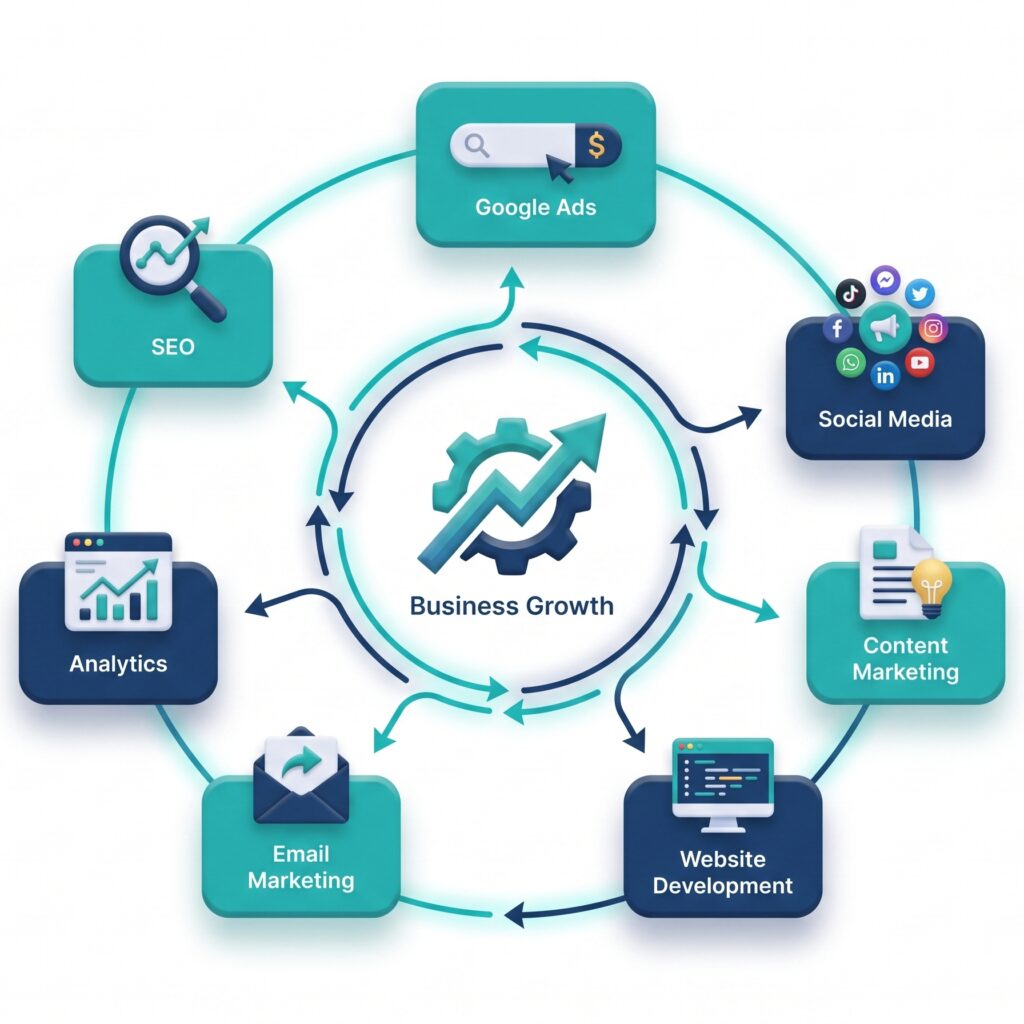
Core Services Offered by a Digital Marketing Agency
- Search Engine Optimization (SEO) — improving a website’s visibility in organic Google search results
- Meta Ads (Facebook & Instagram Ads) — paid advertising for brand awareness and direct response
- Google Ads (PPC) — pay-per-click campaigns that capture high-intent search traffic
- Content Marketing — blog posts, guides, and resources that build authority and drive organic traffic
- Social Media Marketing — organic content, community management, and engagement
- Web Design & Development — building fast, conversion-focused websites (often on WordPress)
- Email Marketing — nurturing leads and retaining existing customers
- Analytics & Reporting — tracking what’s working and reallocating budget accordingly
The goal of any good agency isn’t to sell services — it’s to build a system where each channel supports the others. SEO content drives organic traffic, paid ads accelerate results while SEO builds momentum, and email marketing keeps leads warm until they’re ready to buy.
Why Why Small Businesses Need Digital Marketing Services
The shift toward digital marketing services for small business isn’t a trend — it’s now the default way customers find and evaluate businesses before they ever make contact. Recent industry research shows just how central digital channels have become:
- More than half of small businesses now report relying on digital marketing to connect with customers, and digital ad spending worldwide is on track to pass $850 billion.
- For every $1 spent on digital marketing, businesses typically see an average return of around $5 — a ratio that’s difficult to match with traditional advertising.
- Businesses that maintain an active blog tend to attract significantly more website traffic than those that don’t, which is one reason content marketing remains central to long-term SEO strategy.
- A large share of small business owners plan to increase — not decrease — their marketing budgets this year, with content and digital advertising named as the top priority areas.
What these numbers point to is simple: small businesses that invest consistently in digital marketing grow faster than those that treat it as an occasional expense. The businesses that struggle most aren’t spending too much on marketing — they’re spending too little, or spreading a small budget too thin across too many channels without a clear strategy.
The Confidence Gap
One pattern shows up again and again in small business marketing research: many owners aren’t confident their marketing is actually working, even when the data suggests it is. This usually comes down to three things — limited time to manage campaigns, difficulty measuring ROI across channels, and budgets that are spread too thin to see meaningful results from any single channel. This is precisely the gap a dedicated digital marketing agency is built to close: consistent execution, clear reporting, and a strategy focused on a small number of channels done well rather than every channel done poorly.
Digital Advertising Services Explained
Digital advertising services and organic marketing (like SEO and content) work differently, and understanding the distinction helps small business owners set realistic expectations.
Paid advertising — including Google Ads, Meta Ads, and LinkedIn Ads — puts a business in front of potential customers immediately. You pay for each click or impression, and results generally stop when the budget stops. This makes paid ads ideal for time-sensitive promotions, product launches, or businesses that need leads quickly.
Organic marketing — SEO and content marketing — takes longer to build momentum but continues generating traffic and leads long after the initial investment, without an ongoing per-click cost.
Which Digital Advertising Service Is Right for Your Business?
| Business Situation | Recommended Approach |
| Need leads within days/weeks | Google Ads or Meta Ads |
| Building long-term brand visibility | SEO + Content Marketing |
| Local service business (e.g., contractors, clinics) | Google Business Profile + Local SEO + Google Ads |
| E-commerce brand | Meta Ads + Google Shopping + Email Marketing |
| B2B / professional services | LinkedIn Ads + SEO + Content Marketing |
Most small businesses see the best results from a blended approach — paid ads to generate leads while SEO and content are still building, then gradually shifting budget toward organic channels as rankings improve.
Online Marketing for Small Businesses: A Strategic Framework
Effective online marketing for small businesses doesn’t start with picking a channel — it starts with a strategy. At Next Brand IT, every client engagement follows the same core framework:
- Website & Competitor Audit — identifying technical SEO issues, conversion barriers, and gaps compared to competitors
- Keyword & Audience Research — understanding exactly what potential customers are searching for, in each target market
- Content & Campaign Planning — mapping out a content calendar and ad campaign structure aligned to business goals
- Execution — publishing content, launching ad campaigns, and setting up tracking
- Monthly Reporting & Optimization — reviewing what’s working, cutting what isn’t, and reinvesting in top-performing channels
This structured approach matters more than any single tactic. A small business that consistently executes a focused strategy will consistently outperform one that jumps between random tactics without a plan.
Digital Marketing for Small Businesses in the USA
The US digital marketing landscape is highly competitive, with businesses across nearly every industry investing in Google Ads, SEO, and social media. For small businesses, this means differentiation matters — generic marketing rarely works in a crowded market.
Typical monthly cost range: $750 – $5,000+ USD, depending on scope (SEO alone tends to sit at the lower end; a full-service package with SEO, ads, and content sits higher).
What works well in the US market: Google Ads and Local SEO for service businesses; Meta and TikTok Ads for e-commerce and D2C brands; content marketing for B2B and SaaS companies competing for organic visibility.
Digital Marketing for Small Businesses in the UK
UK small businesses operate under GDPR, which directly affects how email marketing, ad tracking, and customer data collection must be handled. Any agency working with UK clients needs to build campaigns that are compliant from day one — not as an afterthought.
Typical monthly cost range: £600 – £4,000 GBP, depending on service mix.
What works well in the UK market: Local SEO for high-street and service businesses; Google Ads for high-intent searches; LinkedIn for B2B lead generation, which tends to perform strongly among UK business audiences.
Digital Marketing for Small Businesses in Canada
Canada’s bilingual market (English and French, particularly in Quebec) adds a layer of complexity that many agencies overlook. Businesses targeting both English and French-speaking Canadians often need separate keyword research and ad copy for each language.
Typical monthly cost range: $1,000 – $6,000 CAD, depending on scope and whether bilingual campaigns are required.
What works well in the Canadian market: SEO targeting city-specific keywords (Toronto, Vancouver, Calgary); Meta Ads for retail and local service businesses; bilingual content strategy for national brands.
Digital Marketing for Small Businesses in Australia
Australian small businesses benefit from working with agencies in time zones that allow for extended coverage and quick turnaround — something international teams, including Next Brand IT, are well positioned to offer.
Typical monthly cost range: $1,200 – $7,000 AUD, depending on service mix.
What works well in the Australian market: Local SEO for suburb and city-based searches; Google Ads for trades and professional services; Instagram and Meta Ads for retail and hospitality brands.
Common Digital Marketing Mistakes Small Businesses Make
Before choosing an agency — or even before increasing your marketing budget — it’s worth understanding where most small businesses lose money on digital marketing. These mistakes show up consistently across the US, UK, Canada, and Australian markets:
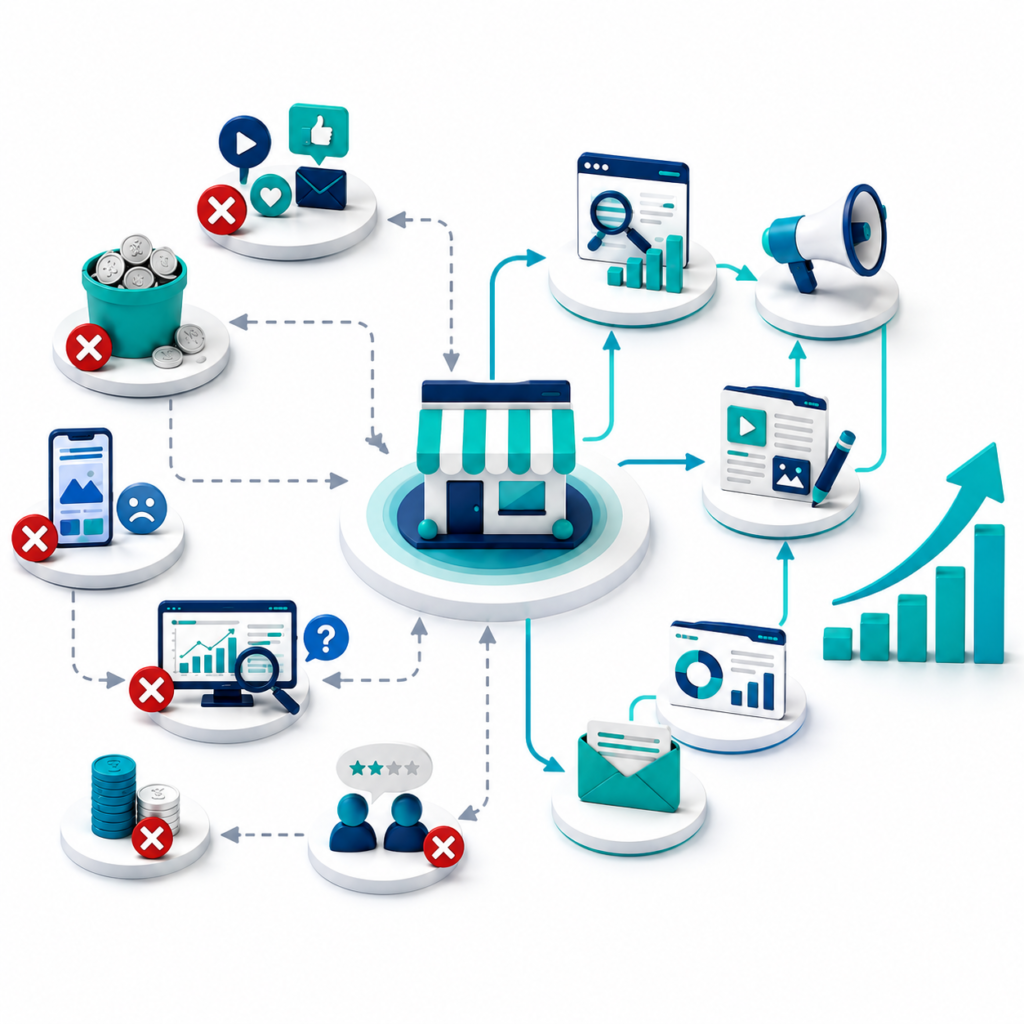
1. Spreading a small budget across too many channels. Trying to run SEO, Google Ads, Meta Ads, email marketing, and TikTok all at once with a limited budget usually means none of them get enough investment to actually work. It’s almost always better to do two channels well than five channels poorly.
2. Treating marketing as a one-time project instead of an ongoing system. A website redesign or a single month of ads rarely produces lasting results. SEO in particular compounds over time — the businesses that see the strongest results are the ones that stay consistent for at least 6–12 months.
3. Ignoring mobile experience. A significant share of small business websites still fail basic mobile performance benchmarks, and mobile users are considerably more likely to contact a business when the site loads quickly and works well on a phone. If a website is slow or hard to navigate on mobile, paid ads are essentially funding traffic that bounces before converting.
4. No clear tracking or reporting. Many small business owners can’t say with confidence which channel is actually driving their leads or sales. Without proper tracking (Google Analytics, call tracking, conversion pixels), it’s impossible to know where to double down and where to cut spend.
5. Under-investing relative to industry norms. Many small businesses spend well below the commonly recommended benchmark of 7–8% of revenue on marketing. Under-investment often becomes self-reinforcing: minimal marketing produces minimal results, which then gets used as evidence that “marketing doesn’t work” — when in reality the investment was never sufficient to generate meaningful results in the first place.
6. Choosing an agency based on price alone. The cheapest option often means the least experienced team, generic strategies copied across every client, or outsourced work with no direct communication. This doesn’t mean small businesses need the most expensive agency — it means the decision should be based on value and fit, not price alone.
Avoiding these six mistakes alone puts a small business ahead of a large share of its competitors —before a single new marketing dollar is even spent.
How to Choose the Right Digital Marketing Agency
Not every agency is the right fit for every business. Here’s a practical checklist to evaluate any digital marketing agency for small business before signing a contract:
- Ask for case studies or real results — not just generic promises. A credible agency should be able to show ranking improvements, traffic growth, or ad performance from past clients.
- Confirm transparent pricing — you should know exactly what’s included in a package, with no hidden fees.
- Check communication style — will you get monthly reports? A dedicated point of contact? Response times matter once a campaign is live.
- Look for relevant industry experience — an agency that has worked with businesses similar to yours will move faster and avoid costly trial-and-error.
- Ask how success is measured — a good agency ties reporting to business outcomes (leads, sales, calls) rather than vanity metrics like impressions alone.
- Understand the contract terms — avoid long-term lock-in contracts with agencies you haven’t worked with before; a 3-month trial period is a healthier starting point.
Red Flags to Avoid When Hiring an Agency
- Guarantees of “#1 ranking on Google” within an unrealistic timeframe
- No clear reporting process or dashboard access
- Pricing that seems too good to be true for the scope of work promised
- Reluctance to share past client results or references
- One-size-fits-all packages with no customization for your industry or market
How Much Does a Digital Marketing Agency Cost?
Pricing varies significantly by country, service scope, and business size. Here’s a general benchmark across the four markets Next Brand IT serves:
| Country | Typical Monthly Range | Best For |
| USA | $750 – $5,000+ | Businesses in competitive, high-population markets |
| UK | £600 – £4,000 | GDPR-compliant local & national campaigns |
| Canada | $1,000 – $6,000 CAD | Bilingual and city-targeted campaigns |
| Australia | $1,200 – $7,000 AUD | Local SEO and trades/service businesses |
Agencies typically price in one of two ways: package-based (a fixed monthly fee for a defined scope of services) or project-based (a one-time fee for a specific deliverable, like a new website). For ongoing marketing — SEO, ads management, content — a package-based model usually provides better long-term value, since these channels require consistent, cumulative effort to show results.
Why Choose Next Brand IT
Next Brand IT is a digital marketing agency built specifically around what small and mid-sized businesses actually need: affordable, transparent, results-driven marketing without the overhead of a large agency.
Our team works directly with clients across the US, UK, Canada, and Australia, offering:
- WordPress development & design — fast, conversion-optimized websites built on a platform you can manage yourself
- SEO — technical, on-page, and off-page SEO built around real keyword research, not guesswork
- Meta Ads & Google Ads management — campaigns built for measurable ROI, not just ad spend
- Content strategy — SEO-driven content that ranks and converts
- Transparent monthly reporting — you’ll always know exactly what’s being done and what results it’s producing
Because our team operates internationally, we’re able to offer the same quality of strategy and execution as larger domestic agencies, at a more accessible price point — without compromising on communication or turnaround time.
Ready to grow your business online? Get a free consultation with Next Brand IT and find out exactly what a tailored digital marketing strategy would look like for your business.
Frequently Asked Questions
What does a digital marketing agency do?
A digital marketing agency manages a business’s online marketing — including SEO, paid advertising, social media, content, and web design — with the goal of increasing visibility, traffic, and sales. Instead of hiring multiple in-house specialists, businesses get an entire marketing team through one partnership.
How much does a digital marketing agency cost for a small business?
Costs typically range from $750–$5,000 USD per month (or the equivalent in GBP, CAD, or AUD), depending on the scope of services, business size, and competitiveness of the industry. Most agencies offer tiered packages to fit different budgets.
Do small businesses really need a digital marketing agency?
Not every business needs a full-service agency, but most benefit from at least some professional support particularly for SEO and paid advertising, where mistakes can waste significant budget. Businesses with limited time or in-house expertise typically see the strongest return from partnering with an agency.
How long does it take to see results from digital marketing?
Paid advertising can generate leads within days. SEO and content marketing typically take 3–6 months to show meaningful ranking improvements, though this varies by industry competitiveness and starting point.
Can a digital marketing agency work with businesses in multiple countries?
Yes. Agencies with international experience — like Next Brand IT — can manage campaigns across multiple countries simultaneously, adjusting for local regulations (such as GDPR in the UK), language differences (such as bilingual Canada), and market-specific platforms and search behavior.
Final Thoughts
Choosing the right digital marketing agency for small business comes down to finding a partner who understands your specific market — whether that’s the US, UK, Canada, or Australia — and who ties every strategy back to measurable business outcomes. At Next Brand IT, that’s exactly the approach we take with every client, regardless of where they’re based.
If you’re ready to build a digital marketing strategy that actually moves the needle, reach out to our team for a free consultation.
Leave a Comment