

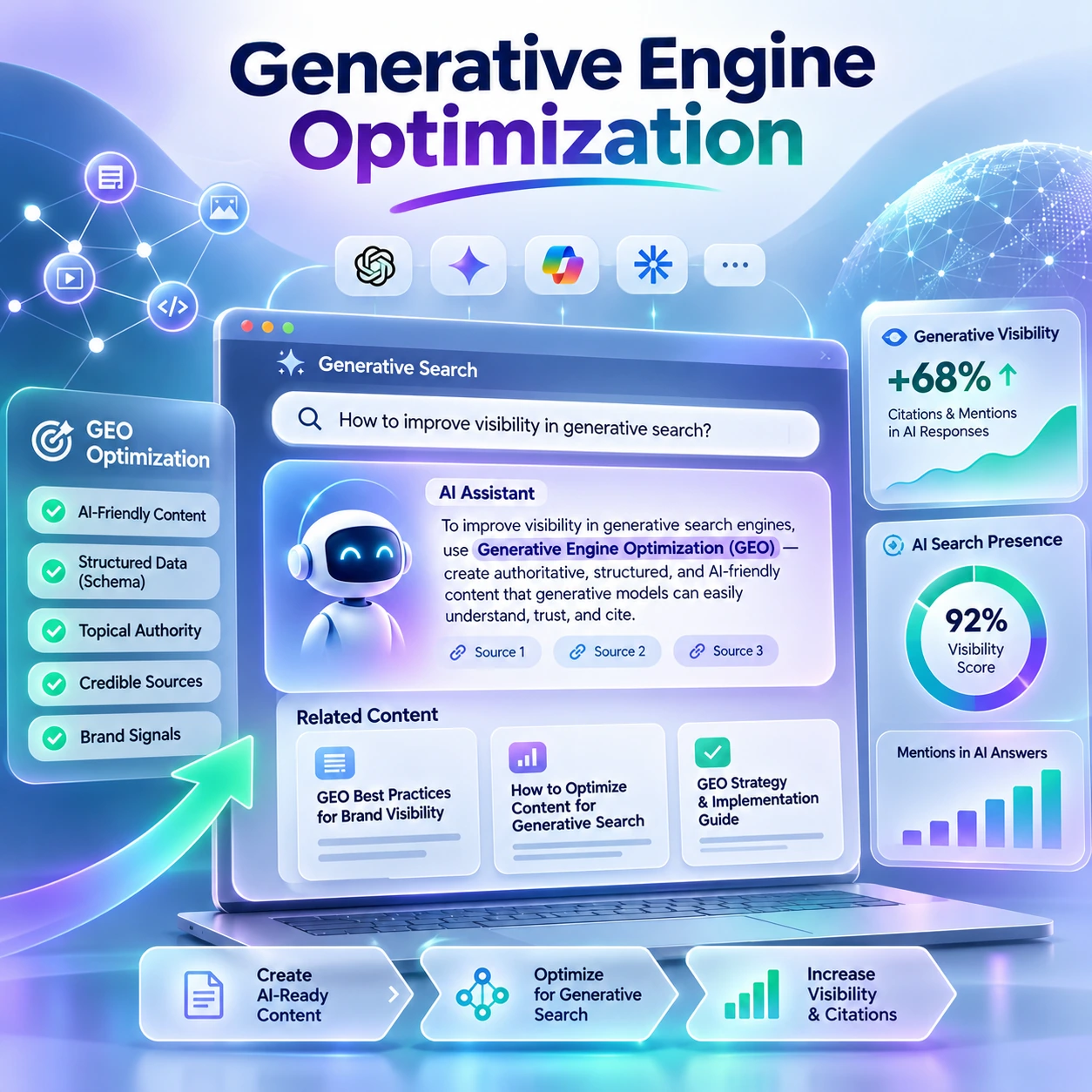
Search is changing. People no longer use only Google to find information. Many now ask questions directly to AI tools like ChatGPT, Google Gemini, and other AI search platforms.
These tools provide direct answers instead of showing only a list of websites. This change creates a new opportunity for businesses. Generative engine optimization helps businesses improve their chances of being found, mentioned, or cited in AI-generated answers.
But how does it work? Is it different from traditional SEO? And what can you do to make your website ready for AI search?
In this guide, we will explain everything in simple words. You will also learn practical ways to improve your online presence and reach more potential customers.
Table of Contents
What Is Generative Engine Optimization (GEO)?
Generative engine optimization (GEO) is the process of improving website content and online information so that AI-powered search tools can understand, use, and potentially mention your brand in their answers.
Traditional search engines show users a list of websites. AI search tools can collect information from different sources and create one answer. They may also provide links to the websites used to support that answer.
For example, someone may ask ChatGPT, “Which digital marketing agency can help a small business grow online?”
The AI tool may suggest different agencies based on available information. It can consider their services, website content, online reputation, and other useful details.
This is where GEO becomes important.
The main goal is to make your business information clear, useful, accurate, and easy for search systems to understand.
However, appearing in an AI answer is not guaranteed. AI tools use different systems, and their results can change over time.
Why Is GEO Important for Businesses?
Customer search habits are changing. People want quick answers and simple solutions. Instead of searching with short phrases, they often ask full questions.
For example, a business owner may search:
- How can I improve my website traffic?
- Which SEO service is best for a small business?
- How much does website development cost?
- How can I get more customers through digital marketing?
AI tools can answer these questions by collecting information from different sources.
This creates a new way for brands to reach potential customers.
Here are some reasons why businesses should pay attention to GEO.
1. Reach People Through AI Search
Your potential customers may use AI tools before visiting a website. If an AI tool finds useful information about your brand, it may include your website as a supporting source.
This gives your business another chance to reach people online.
2. Build Brand Awareness
People may learn about your business even before they visit your website.
For example, if an AI tool mentions your company when someone asks about web design services, that person may become interested in your brand.
Repeated visibility across trusted sources can help people become more familiar with your business.
3. Build Trust and Authority
AI search systems aim to provide useful and reliable information.
When your website shares clear facts, useful advice, and relevant details, it gives both users and search systems a better understanding of your business.
Good information can also help visitors feel more confident about your services.
4. Reach More Relevant Customers
People often ask detailed questions before making a purchase.
For example, someone looking for an SEO agency may ask about pricing, services, results, and experience.
Useful content that answers these questions can attract people who are already interested in your services.
5. Prepare for Changes in Search
Search technology will continue to change. Businesses that focus only on one way of getting traffic may miss new opportunities.
A balanced approach to traditional SEO and AI search can help your business stay ready for these changes.
GEO vs SEO: What Is the Difference?
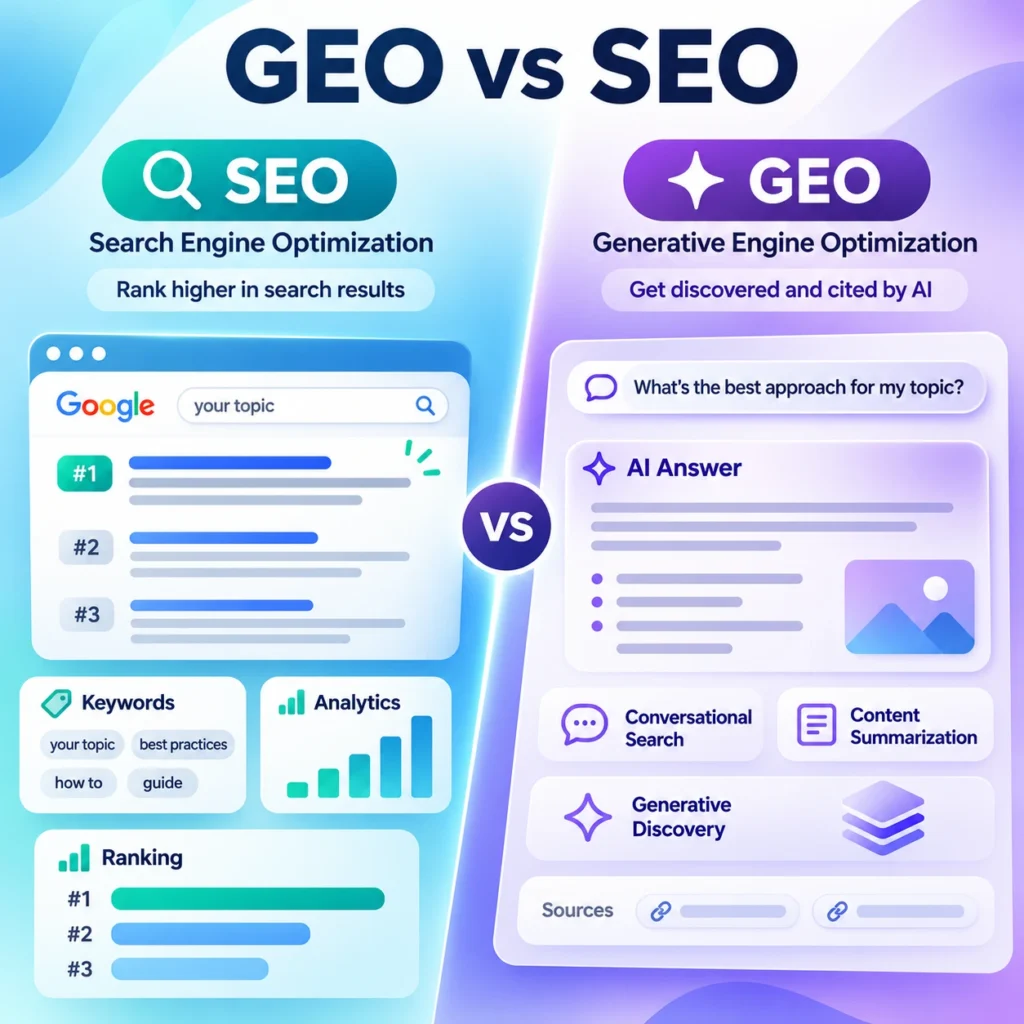
GEO and SEO have a similar goal: helping people discover useful information about your business.
However, they focus on different search experiences.
SEO (Search Engine Optimization) helps websites become more visible in traditional search results. GEO focuses on improving the chances of being included in AI-generated answers.
Let’s understand the main differences.
| Comparison | Traditional SEO | GEO |
|---|---|---|
| Main goal | Improve search visibility | Improve visibility in AI answers |
| Search platform | Google and Bing | ChatGPT and AI-powered search |
| Main result | Website listings | AI-generated answers and citations |
| Content focus | Relevant and useful content | Clear, detailed and answer-focused content |
| User search | Keywords and questions | Natural questions and conversations |
| Success measurement | Rankings, clicks and traffic | AI mentions, citations and referral visits |
How Do SEO and GEO Work Together?
GEO does not mean that you should stop doing SEO.
In fact, traditional SEO is still an important part of AI search visibility. Search systems need to find and understand your website before its content can be considered for many search experiences.
For example, a technically healthy website with useful content has a stronger foundation than a website with broken pages and unclear information.
You should focus on both areas:
- Improve website structure and technical SEO.
- Create helpful content that answers real questions.
- Build a clear brand identity.
- Share accurate business information.
- Earn relevant links and brand mentions.
- Keep your content fresh and useful.
The best approach is to make your website useful for people and easy for search systems to understand.
How Does Generative Engine Optimization Work?
AI-powered search tools do not all work in the same way. Some use search results, while others may use their own data, connected sources, or a mix of different information systems.
In general, they try to understand a user’s question and find information that can help create an answer.
Here is a simple look at the process.
Step 1: Understanding the Question
The AI system first tries to understand what the user wants.
For example, “How can a small business get more website visitors?” shows that the user wants practical marketing advice.
Step 2: Finding Useful Information
The system may look for relevant information from websites and other available sources.
It tries to find content that matches the question.
Step 3: Checking Relevant Details
The system processes information to understand which details may help answer the question.
Clear facts, useful explanations, and relevant context can make content easier to use.
Step 4: Creating an Answer
The AI tool creates an answer using information it considers relevant.
Depending on the platform and query, it may also show links to supporting websites.
This is why clear and useful website content matters.
7 Effective Generative Engine Optimization Strategies
If you want your business to become more visible in AI search, you need a clear plan.
There is no guaranteed shortcut. However, some practical steps can improve your website quality and make your information easier to discover and understand.
Let’s explore seven useful strategies.
1. Create Helpful and Original Content
Content is one of the most important parts of GEO.
Your website should provide real value instead of repeating information that is already available everywhere.
For example, if you run a digital marketing agency, do not publish only general articles about SEO.
Create content that answers real customer problems.
You can write about:
- How to choose the right SEO service for a small business.
- Common website errors that reduce search visibility.
- How Google Ads can help generate leads.
- SEO strategies for local businesses.
- How to improve website speed and user experience.
Add useful examples, practical steps, and your own knowledge.
Original content gives readers a reason to choose your website over other sources.
2. Answer Questions Directly
People often use AI tools to ask complete questions.
Your content should make these answers easy to find.
For example, if your topic is local SEO, include a clear question such as “What is local SEO?”
Then answer it in two or three simple sentences before explaining the topic in more detail.
You can also include questions like:
- Why does local SEO matter?
- How does local SEO help small businesses?
- What are the main local SEO ranking factors?
- How long does local SEO take?
This approach makes your content easier for readers to follow.
It also supports AI search optimization by creating clear answers around specific topics.
3. Use Clear Headings and Content Structure
A well-organized article is easier to read and understand.
Use one main H1 heading for the page. Then divide the content into relevant H2 and H3 sections.
Keep each section focused on one topic.
For example:
- H1: Complete Guide to Local SEO
- H2: What Is Local SEO?
- H2: Why Is Local SEO Important?
- H2: How to Improve Local SEO
- H3: Optimize Your Google Business Profile
- H3: Collect Genuine Customer Reviews
Use short paragraphs and simple words.
You can also use tables, numbered steps, and bullet points when they make information easier to understand.
Do not divide every small sentence into a separate section. A natural reading flow is more important than adding too many headings.
4. Build Strong Brand Information
Your brand should have a clear identity across the internet.
AI tools may use different sources to understand a business. If your company information is inconsistent, it can be harder for people and search systems to understand your brand.
Make sure these details are clear:
- Business name and website.
- Main services and products.
- Business location and contact details.
- Company background.
- Team information.
- Customer reviews and case studies.
Keep your business information consistent across your website, social media profiles, and relevant business directories.
For example, NextBrand IT provides services such as SEO, web development, branding, social media marketing, graphic design, and content creation.
Clear service pages can help explain what the company does and which customers it serves.
5. Improve Your Website’s Technical SEO
Good content alone is not enough.
Your website should also be technically healthy so search engines can find and process its pages.
Focus on these areas:
- Make sure important pages can be crawled.
- Check whether important pages are indexed.
- Fix broken links and error pages.
- Improve website loading speed.
- Make the website mobile-friendly.
- Use a clear URL structure.
- Add relevant internal links.
- Submit an updated XML sitemap.
- Check your robots.txt file.
Technical SEO creates a strong base for AI search optimization.
Also, make sure important information is available as readable text. Do not place all important details inside images.
6. Use Structured Data Correctly
Structured data is a way to describe website information in a format that search engines can understand.
For example, you can use suitable schema markup for:
- Organization information.
- Local business details.
- Articles and blog posts.
- Products and services.
- Breadcrumb navigation.
Structured data can help search engines understand the purpose of a page.
However, there is an important point to remember.
Google does not require special GEO schema or special AI markup to appear in AI Overviews. Your structured data should match the visible information on your website and follow Google’s guidelines.
Do not add irrelevant schema just to attract AI search systems.
7. Build Online Trust and Authority
People trust businesses that provide useful information and show real experience.
The same idea matters when building a strong online presence.
You can improve brand trust through:
- Genuine customer reviews.
- Relevant industry mentions.
- Useful guest articles.
- Expert contributions.
- Real project examples.
- Clear author information.
- Accurate service descriptions.
For example, if your agency completes a website development project, create a case study.
Explain the client’s problem, your work process, and the final result. Use real details and avoid making claims you cannot prove.
These activities help build a stronger brand presence across the web.
How to Improve Your Content for ChatGPT SEO
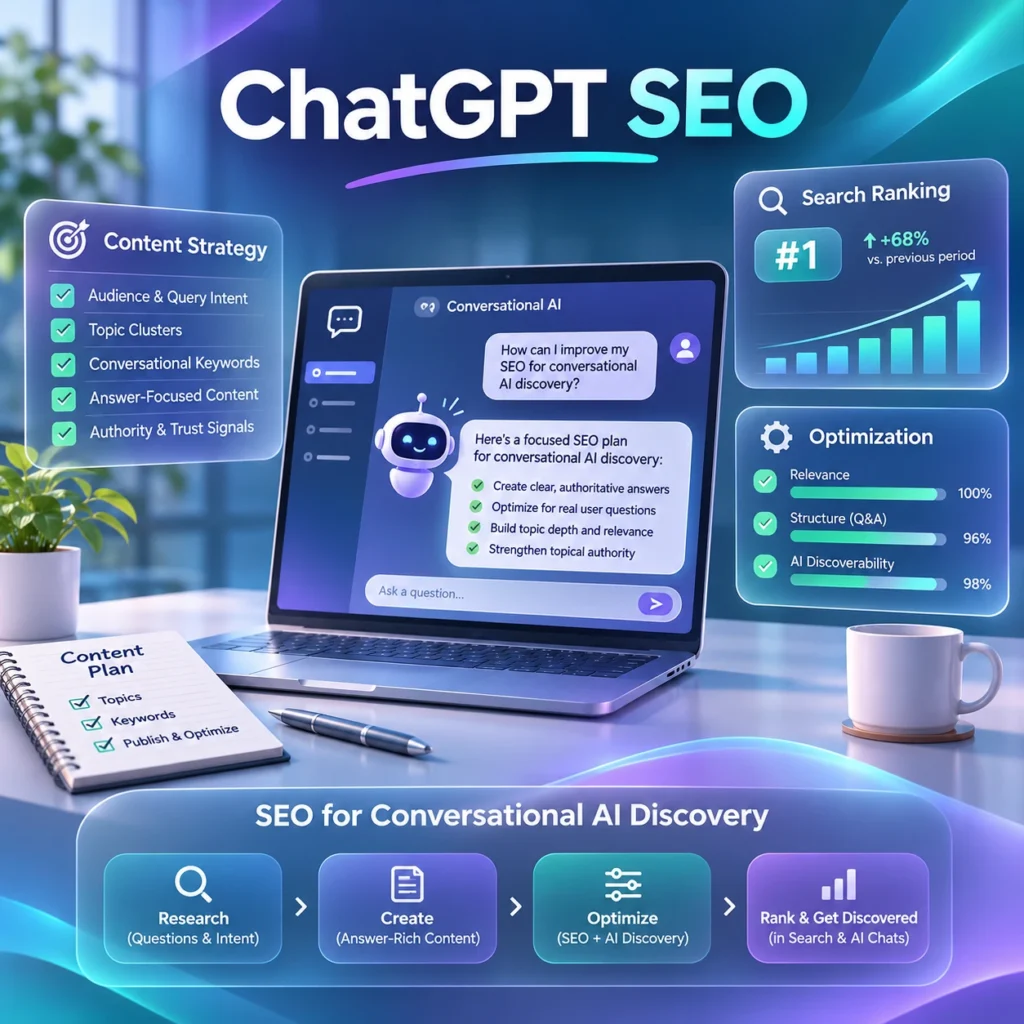
ChatGPT SEO refers to the process of making your brand and website information easier to discover and understand in ChatGPT-related search experiences.
It is not a separate ranking system with a guaranteed formula.
You cannot force ChatGPT to mention your business. But you can improve the quality and accessibility of your online information.
Here are some useful steps.
1. Publish clear service pages.
Explain each service, its benefits, and the problems it solves. Avoid using vague descriptions.
2. Answer common customer questions.
Create helpful FAQ sections based on real questions from your target audience.
3. Share useful facts.
Include accurate prices, service details, locations, product features, and other relevant information when appropriate.
4. Keep your website updated.
Review old content and correct information that is no longer accurate.
5. Make your website accessible to relevant crawlers.
Review your technical setup and check the access rules for the search and AI services you want to reach.
6. Build a strong online presence.
Keep your brand information clear and consistent across trusted websites and platforms.
The main idea is simple: give people and AI systems a clear reason to understand your business.
What Are Google AI Overviews and How Do They Affect SEO?
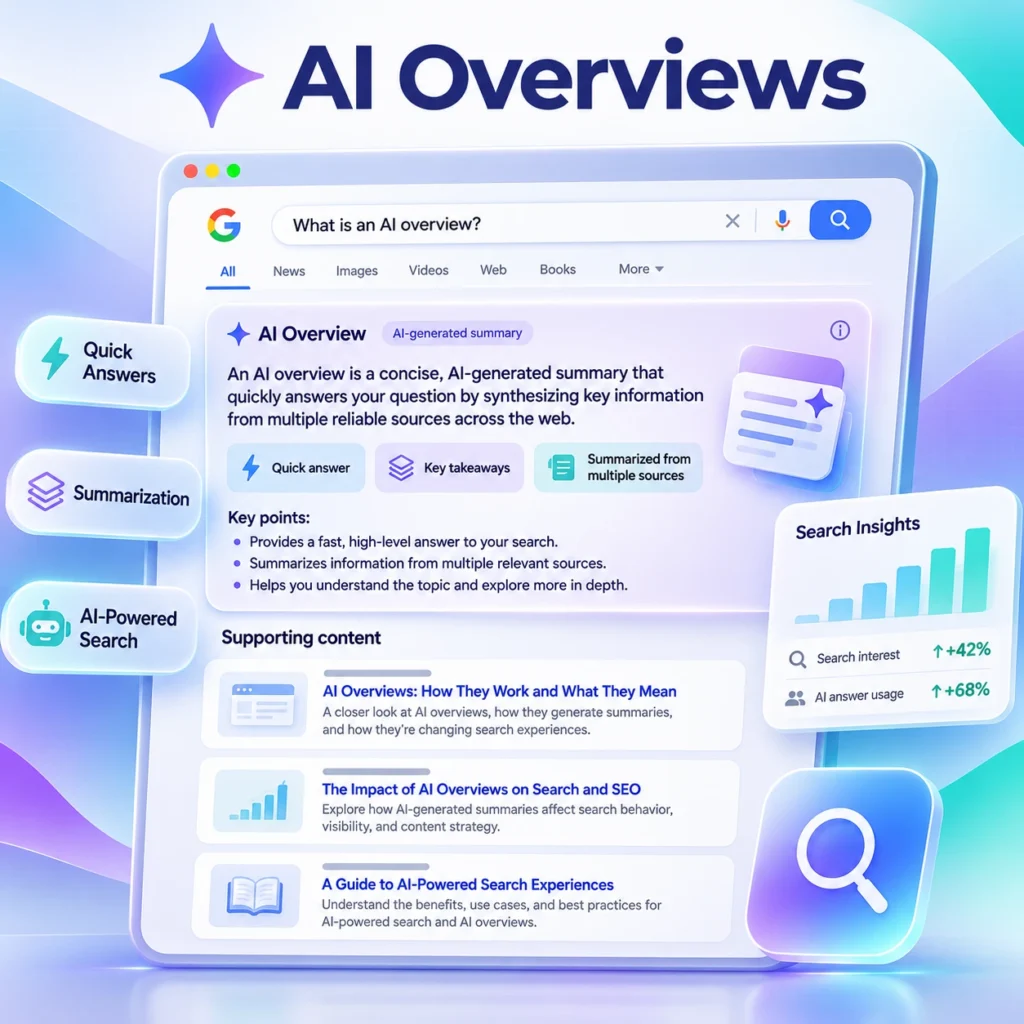
AI Overviews are AI-generated summaries that can appear in Google Search for certain queries.
Instead of showing only traditional website listings, Google may provide a summary with links to relevant web pages.
For example, someone may search, “How can I improve my website’s SEO?”
Google may show an AI-generated overview with helpful information and links to websites that support the answer.
This changes how people discover information.
A user may get a quick answer without opening several websites. However, they may still visit a website when they need more details, expert advice, or a service.
How Can Your Website Improve Its Chances of Appearing in AI Overviews?
There is no guaranteed method to appear in AI Overviews.
However, you can follow Google’s existing SEO guidance.
- Create useful and original content.
- Make sure your important pages are indexed.
- Answer search questions clearly.
- Use relevant internal links.
- Keep your website technically healthy.
- Provide accurate and updated information.
- Use suitable images and videos where they add value.
Remember, ranking in traditional search results does not guarantee an AI Overview mention.
Google selects supporting links based on its own systems and the needs of each search.
How to Measure Your GEO Performance
You should not judge your GEO efforts only by keyword rankings.
AI search visibility can be different from traditional search performance.
A useful measurement plan should include several areas.
1. Brand Mentions
Check whether AI tools mention your business when users ask relevant questions.
Test different questions related to your services and target market.
2. AI Citations
Check whether AI search tools link to your website as a supporting source.
A mention without a link and a citation with a link are not the same.
3. Referral Traffic
Use Google Analytics 4 (GA4) to review traffic from AI-related platforms where referral information is available.
Look at sessions, engagement, and conversions.
4. Search Performance
Use Google Search Console to monitor impressions, clicks, and search queries.
Google also provides reporting for performance in its generative AI search experiences. Check the available reports in your account.
5. Leads and Sales
Traffic is useful, but business results matter more.
Track contact form submissions, phone calls, consultation requests, and sales.
Review these numbers regularly to understand whether your content is reaching the right audience.
Common GEO Mistakes Businesses Should Avoid
Many businesses want quick visibility in AI search. Because of this, they may follow poor advice or use methods that do not provide long-term value.
Avoid these common mistakes.
Keyword stuffing: Repeating the same phrase again and again makes content hard to read. Use keywords naturally.
Publishing AI content without editing: AI tools can help with research and writing, but they can also make mistakes. Always review facts and add real value.
Ignoring traditional SEO: GEO does not replace technical SEO, on-page SEO, or quality content.
Creating unnecessary pages: Do not publish many pages that answer almost the same question. Focus on useful and different topics.
Using false reviews: Fake reviews can damage your brand trust. Collect genuine customer feedback.
Adding irrelevant schema: Structured data should describe the actual content of a page.
Expecting instant results: Search visibility takes time. Keep improving your website and track progress regularly.
Frequently Asked Questions About Generative Engine Optimization
1. What is generative engine optimization in simple words?
Generative engine optimization is the process of improving your website and brand information so AI-powered search tools can understand and potentially use it in their answers.
2. Is GEO better than SEO?
Neither is automatically better. SEO helps your website appear in traditional search results, while GEO focuses on visibility in AI-generated answers. Both support online growth.
3. What is the difference between GEO and SEO?
SEO focuses on improving website visibility in search engine results. GEO focuses on improving the chances of your content or brand appearing in AI-generated responses.
4. Does GEO replace traditional SEO?
No. Traditional SEO remains important. Website crawling, indexing, helpful content, internal links, and technical health are still important for search visibility.
5. How can my website appear in ChatGPT answers?
Create helpful content, maintain accurate business information, improve website accessibility, and build a trusted online presence. However, no strategy can guarantee a ChatGPT mention.
6. What is ChatGPT SEO?
ChatGPT SEO is a common term for improving a brand’s discoverability in ChatGPT-related search experiences. It involves useful content, clear business information, and good website practices.
7. How do AI Overviews affect website traffic?
AI Overviews may answer some questions directly, which can change the number and type of website clicks. However, they can also provide links to useful websites and bring relevant visitors.
8. Do I need special schema for GEO?
No special GEO schema is required for Google AI Overviews. You should still use suitable structured data when it helps describe your website content correctly.
9. How long does generative engine optimization take?
There is no fixed timeline. Results depend on your website, content quality, competition, and the AI platform. Focus on regular improvements rather than expecting instant results.
10. Can small businesses benefit from GEO?
Yes. Small businesses can create useful service pages, answer customer questions, share local information, collect genuine reviews, and build a clear online presence. These steps can improve their chances of being discovered through different search channels.
Final Thoughts
Search is moving beyond the traditional list of website links. AI tools are changing how people find information, compare services, and make decisions.
Generative engine optimization gives businesses another reason to improve their content, website quality, and online reputation.
But you do not need to forget everything you have learned about SEO. A strong website, helpful content, clear business information, and genuine trust are still important.
Start with the basics. Improve your website structure, answer customer questions, publish original content, and keep your information accurate.
At NextBrand IT, we believe that a strong digital presence starts with the right strategy. By combining SEO, quality content, and a user-focused website, your business can prepare for the changing world of online search.
Want to improve your website’s online visibility? Contact NextBrand IT and explore the right digital growth strategy for your business.
Grow Your Business with NextBrand IT
Building a strong online presence takes the right strategy, useful content, and consistent effort. At NextBrand IT, we help businesses grow through SEO, web development, social media marketing, branding, and creative digital solutions.
Want to improve your website visibility and reach more customers? Contact NextBrand IT today to discuss your business goals and find the right digital marketing strategy.