

A business that ranks well at home doesn’t automatically rank anywhere else. The moment a company starts selling into the US, UK, Canada, and Australia at the same time, local SEO tactics stop being enough — search behavior, competition, and even spelling conventions shift from one market to the next. This is where international seo services come in.
At Next Brand IT, we help growing businesses build a single, coordinated SEO strategy that performs across multiple English-speaking markets at once — without duplicating work four times over. This guide covers what international SEO actually involves in 2026, what a global seo strategy needs technically, what it costs, and how to choose the right seo services provider for a multi-country expansion.
Quick answer: International SEO is the process of optimizing a website so it ranks in search results across multiple countries and, where relevant, multiple languages — combining technical setup (like hreflang tags), localized keyword research, and region-specific content and link building.
What Is International SEO?
International SEO extends standard SEO practice to work across borders. Instead of optimizing for a single country’s search results, it optimizes a website to rank correctly in each target country’s version of Google — while avoiding duplicate content penalties and making sure UK users see UK-relevant pages instead of US ones (and vice versa).
This matters more than most businesses assume. Google now holds close to 90% of the global search market, and the SEO services market itself has grown into a $100+ billion industry in 2026 — a sign of just how central organic search has become to how businesses expand internationally.
Local SEO vs. International SEO: Key Differences
| Factor | Local SEO | International SEO |
| Targeting scope | Single city/country | Multiple countries and/or languages |
| Technical setup | Standard on-page SEO | Hreflang tags, URL structure, geo-targeting |
| Keyword research | One market’s search behavior | Per-market research (spelling, terminology, intent) |
| Content strategy | Single content calendar | Localized/adapted content per region |
| Link building | Local citations & directories | Region-specific domains & directories |
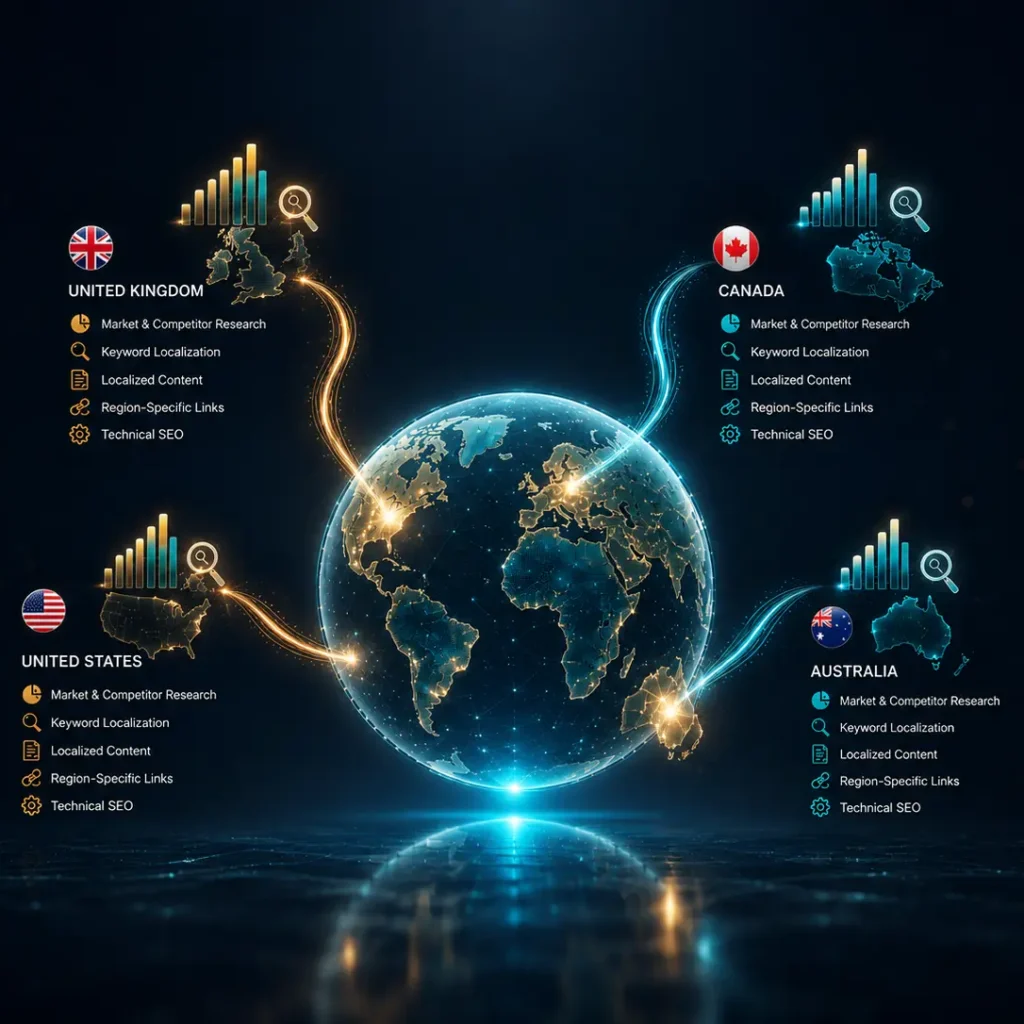
What Does a Global SEO Strategy Actually Include?
A proper global seo strategy isn’t just “translate the website and hope for the best.” It’s built on five core pillars that work together:
- Market & Competitor Research — understanding search demand and competition separately in each target country
- Technical Setup — hreflang tags, URL structure, and international targeting in Google Search Console
- Keyword Localization — adapting keywords for spelling, terminology, and search intent differences between markets
- Content Adaptation — not just translation, but rewriting content to match local tone, currency, and examples
- Region-Specific Link Building — earning backlinks from domains relevant to each target country
Choosing Your International SEO Structure: ccTLD vs. Subdirectory vs. Subdomain
| Structure | Example | Pros | Cons |
| ccTLD | nextbrandit.co.uk | Strongest geo-signal, highest local trust | Most expensive to maintain, separate domain authority per country |
| Subdirectory | nextbrandit.com/uk/ | Shares domain authority, easiest to manage | Slightly weaker geo-signal than ccTLD |
| Subdomain | uk.nextbrandit.com | Some separation for regional teams | Often treated as a semi-separate site by Google |
For most small and mid-sized businesses targeting the US, UK, Canada, and Australia, a subdirectory structure offers the best balance — it consolidates domain authority into one site while still allowing country-specific pages.
Common International SEO Mistakes Businesses Make
Before hiring a provider or attempting international SEO in-house, it’s worth understanding where most multi-country campaigns go wrong. These patterns show up consistently across businesses expanding into the US, UK, Canada, and Australia:
1. Treating translation as localization. Simply translating or re-spelling US content for a UK audience (“optimization” to “optimisation”) isn’t the same as localizing it. Currency, examples, cultural references, and even the tone that resonates with each market need to be adapted — not just the spelling.
2. Launching all markets at once with a stretched budget. Attempting to fully localize and rank in four countries simultaneously with a budget suited for one market usually means every market gets a shallow, under-resourced effort. A phased rollout — starting with one or two priority markets — almost always outperforms an all-at-once approach with the same total budget.
3. Ignoring hreflang until something breaks. Hreflang errors are largely invisible until they start suppressing rankings — a business might not notice for months that Google is showing the wrong country’s page to a segment of its audience. Auditing hreflang implementation should happen at setup, not as a reaction to a traffic drop.
4. Duplicating content across country pages without differentiation. Near-identical content across US, UK, Canada, and Australia pages, differentiated only by spelling, gives Google very little reason to treat them as distinct, locally relevant pages — and can trigger duplicate content issues that suppress all versions rather than just one.
5. Measuring performance with one blended metric. A campaign might look successful overall while one or two markets are actually underperforming and dragging down the average. Per-country reporting isn’t a nice-to-have in international SEO — without it, it’s impossible to know where the strategy is actually working.
6. Underestimating the timeline. International SEO compounds the same way domestic SEO does, but across more variables. Multilingual and multi-market SEO efforts typically need 12-18 months before newer markets reach a meaningful share of total organic traffic — businesses expecting UK or Australian results as fast as their established US rankings are often setting themselves up for disappointment.
Avoiding these six mistakes is often the difference between an international SEO campaign that compounds successfully and one that quietly stalls in two of its four target markets.
Why Businesses Hire an International SEO Agency
Running international SEO in-house is possible, but it’s rarely efficient. An international seo agency brings a few advantages that are hard to replicate internally:
- Speed of execution — an experienced team can set up hreflang, country targeting, and localized content calendars in weeks, not months
- Market-specific search knowledge — understanding how UK searchers phrase queries differently from US searchers isn’t guesswork, it’s pattern recognition built from working across markets
- Avoiding costly technical mistakes — a Semrush audit of 20,000 multilingual websites found that 58% had internal hreflang conflicts and 37% had broken hreflang links, both of which can quietly suppress rankings for months before anyone notices
- Parallel execution across markets — instead of sequentially tackling the US, then UK, then Canada, an agency can run all four markets simultaneously
The businesses that struggle most with international SEO aren’t the ones with small budgets — they’re the ones trying to manage four markets’ worth of technical and content work with a team built for one.
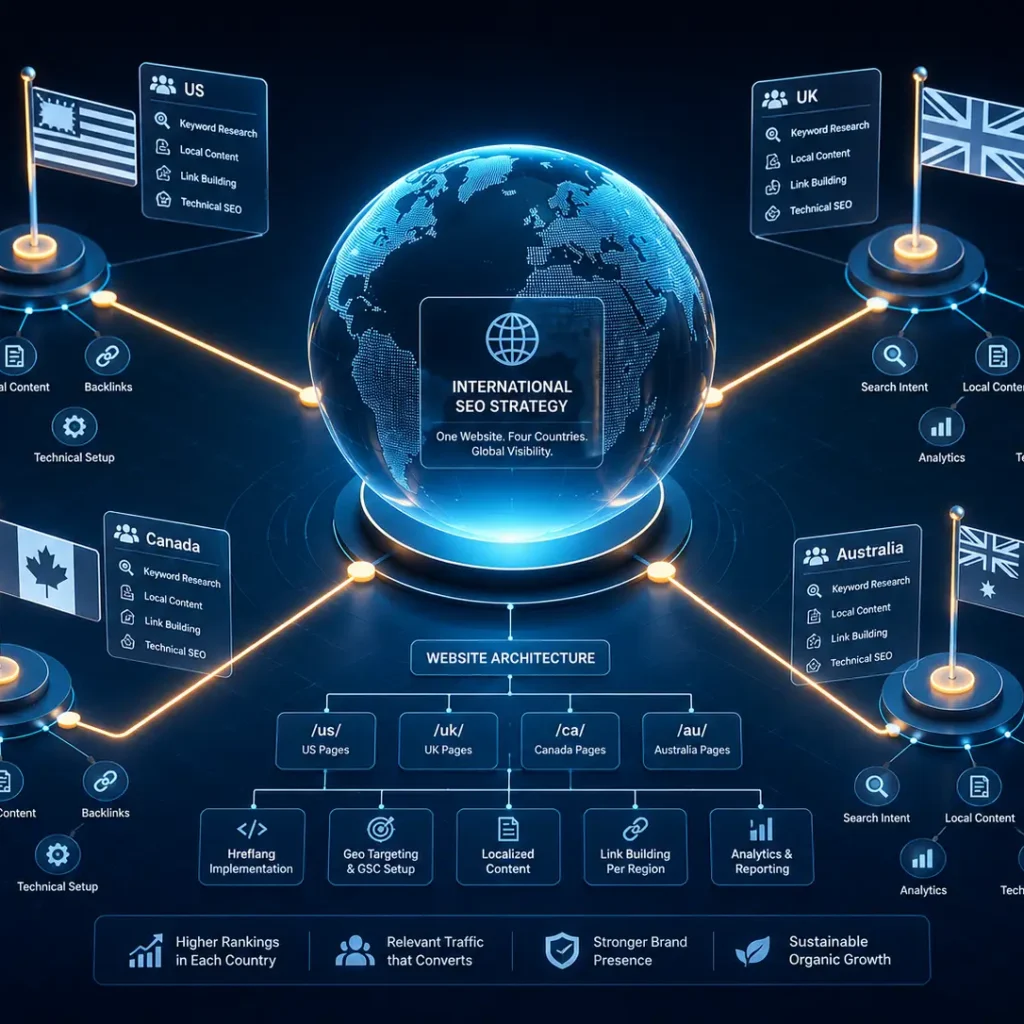
Technical Foundations: Hreflang, Geo-Targeting & Site Structure
This is the part of international SEO most businesses get wrong — and where an experienced provider adds the most value.
Hreflang tags tell Google which version of a page to show to which audience (for example, en-us vs en-gb vs en-ca vs en-au). Done incorrectly, hreflang errors can cause the wrong country’s page to rank in the wrong search results, or cause Google to treat near-duplicate content as a ranking problem instead of an intentional localization.
Geo-targeting in Google Search Console lets a business signal which country a specific section of the site is meant for — useful when using a subdirectory structure like nextbrandit.com/uk/.
Site speed and Core Web Vitals also need to be evaluated per region, not just at headquarters. A site that loads quickly for US visitors can behave very differently for UK or Australian visitors depending on server location and CDN configuration — which is why serving international traffic through a properly configured CDN matters as much as the content itself.
Country-specific XML sitemaps help search engines prioritize crawling the right pages for the right market, rather than relying entirely on internal linking to signal importance.
International Keyword Research & Content Localization
Keyword research for international SEO isn’t a translation exercise — it’s a research exercise repeated per market. The same product or service can be searched for using entirely different terms depending on the country.
Keyword Research for Multiple English-Speaking Markets (US vs UK vs Canada vs Australia)
Even across English-speaking countries, search behavior varies more than most businesses expect:
- Spelling differences: “optimization” (US/Canada) vs “optimisation” (UK/Australia); “color” vs “colour”
- Terminology differences: “vacation” (US) vs “holiday” (UK/Australia); “apartment” (US) vs “flat” (UK)
- Commercial terms: pricing searches often include local currency terms — “cost in USD” vs “cost in GBP” vs “cost in AUD”
- Search intent shifts: the same keyword can carry different intent in different markets depending on local competition and buying habits
Roughly 70% of global search queries are non-English, and worldwide language preference plays a measurable role even within English-speaking regions — research shows the majority of online shoppers prefer buying in language and terminology that feels native to them. For a business targeting US, UK, Canada, and Australia simultaneously, this means keyword research has to be run four times, not once.
International SEO for the USA
The US remains the largest and most competitive English-speaking search market, and North America alone accounts for roughly a third of global SEO services revenue. Businesses targeting the US need to balance broad national keywords with city or state-level local SEO, especially for service-based businesses competing against well-established local players.
International SEO for the UK
UK SEO carries a few distinctions worth planning for early: deciding between a .co.uk domain or a subdirectory on a .com, adjusting spelling and terminology (optimisation, colour, favourite), and factoring in GDPR when setting up analytics and tracking for UK visitors. UK search behavior also tends to favor detailed, information-first content over aggressively sales-oriented pages.
International SEO for Canada
Canada’s bilingual market — particularly the English/French split concentrated in Quebec — adds a layer international SEO strategies for other markets don’t need to account for. Businesses serious about the Canadian market often need separate English and French content tracks, along with city-based targeting for major markets like Toronto, Vancouver, and Montreal.
International SEO for Australia
Australia’s search market rewards strong local SEO fundamentals — Google Business Profile optimization, local directory citations, and suburb-level keyword targeting — combined with standard national SEO for broader visibility. Time zone alignment also matters operationally: agencies able to offer coverage that overlaps with Australian business hours tend to execute campaigns and resolve issues faster.
How Much Does International SEO Cost?
Seo marketing cost for international campaigns is typically higher than single-market SEO, simply because the work multiplies per country — separate keyword research, separate content calendars, and separate technical audits.
| Scope | Typical Monthly Range | Notes |
| Single-market SEO | $750 – $2,500 USD | One country, one keyword set |
| 2-country international SEO | $1,500 – $4,500 USD | Shared technical setup, separate content/keywords |
| 3–4 country international SEO (US, UK, Canada, Australia) | $2,500 – $8,000+ USD | Full localization, region-specific reporting |
| One-time technical audit (hreflang, structure) | $500 – $2,000 USD | Often a starting point before ongoing work begins |
Pricing is typically structured as either a flat monthly retainer covering all target markets, or per-market packages that can be added incrementally as a business expands into new countries. For most businesses starting international SEO for the first time, launching in one or two markets and expanding once results are visible is more capital-efficient than launching all four countries simultaneously.
How to Choose the Right SEO Services Provider
Not every SEO provider that says “we do international SEO” actually has the technical depth to do it correctly. Here’s what to check before hiring a seo services provider for a multi-country campaign:
- Ask for multi-market case studies — not just domestic results. Ranking a site in one country is a different skill set from coordinating rankings across four.
- Confirm hreflang and technical SEO expertise specifically — this is the area most agencies get wrong, and errors here can silently suppress rankings for months.
- Request per-country reporting — a provider should be able to show ranking and traffic performance broken out by market, not one blended number.
- Ask about content localization process — find out whether content is truly adapted per market or simply translated.
- Check realistic timelines — international SEO, like standard SEO, compounds over time; expect meaningful results within 4-6 months, with non-branded traffic in newer markets often taking 12+ months to mature.
Questions to Ask Before Hiring an International SEO Services Provider
- How do you structure hreflang tags for our specific site setup?
- Will content be localized per market, or only translated?
- How do you report results separately by country?
- What’s your experience with our specific target markets?
- What’s the realistic timeline before we see ranking movement in each country?
Why Choose Next Brand IT
Next Brand IT provides international SEO services built specifically for businesses expanding across the US, UK, Canada, and Australia — without the overhead or slow turnaround of a large multinational agency.
Our approach includes:
- Technical SEO audits covering hreflang, site structure, and international targeting setup
- Per-market keyword research that accounts for spelling, terminology, and search intent differences across all four countries
- Localized content strategy — not direct translation, but content adapted to how each market actually searches and buys
- Region-specific reporting so you always know exactly how each country is performing, not just a blended average
- Coordinated link building across country-relevant domains and directories
Because our team works across multiple time zones and markets as a core part of our service — not as an occasional project — we’re able to launch and manage multi-country SEO campaigns more efficiently than agencies built primarily around a single domestic market.
Ready to expand your organic visibility internationally? Get a free international SEO audit from Next Brand IT and see exactly where your current site stands in each target market.
Frequently Asked Questions
What is international SEO?
International SEO is the practice of optimizing a website to rank in search results across multiple countries and, where relevant, multiple languages. It combines technical setup like hreflang tags with market-specific keyword research, content localization, and regional link building.
How is international SEO different from local SEO?
Local SEO focuses on ranking within a single city or country, typically for businesses with a physical location or a single target market. International SEO expands this to multiple countries simultaneously, requiring separate technical configuration, keyword research, and content strategy for each target market.
Do I need hreflang tags for international SEO?
Yes, if you’re targeting more than one country or language with similar or overlapping content. Hreflang tags tell Google which version of a page to show to which audience, preventing duplicate content issues and ensuring the correct regional page appears in each country’s search results.
How much does international SEO cost?
Costs vary based on how many markets are targeted, but typically range from $1,500–$4,500 USD per month for two markets, up to $2,500–$8,000+ USD per month for a full four-market campaign covering the US, UK, Canada, and Australia.
How long does international SEO take to show results?
Most businesses start seeing measurable ranking movement within 4-6 months, though newer, non-branded keywords in additional markets can take 12 months or longer to mature — particularly in competitive industries.
Can one SEO strategy work across the US, UK, Canada, and Australia?
Not directly. While these countries share a language, search behavior, spelling, terminology, and competition levels differ enough that each market needs its own keyword research and, in many cases, adapted content — even if the underlying technical setup and site structure are shared.
Final Thoughts
International SEO in 2026 isn’t optional for businesses serious about growing beyond a single market — it’s the infrastructure that determines whether a US, UK, Canadian, or Australian customer can even find you in the first place. The technical details (hreflang, site structure, per-market keyword research) are unforgiving of shortcuts, which is exactly why choosing the right international seo services partner matters as much as the strategy itself.
If you’re ready to build a coordinated global seo strategy across the US, UK, Canada, and Australia, reach out to Next Brand IT for a free international SEO audit.
[…] $3,000, $8,000, sometimes more. It’s not that four of them are lying. It’s that “SEO” can mean a dozen different things depending on who’s selling it, and nobody bothers […]