
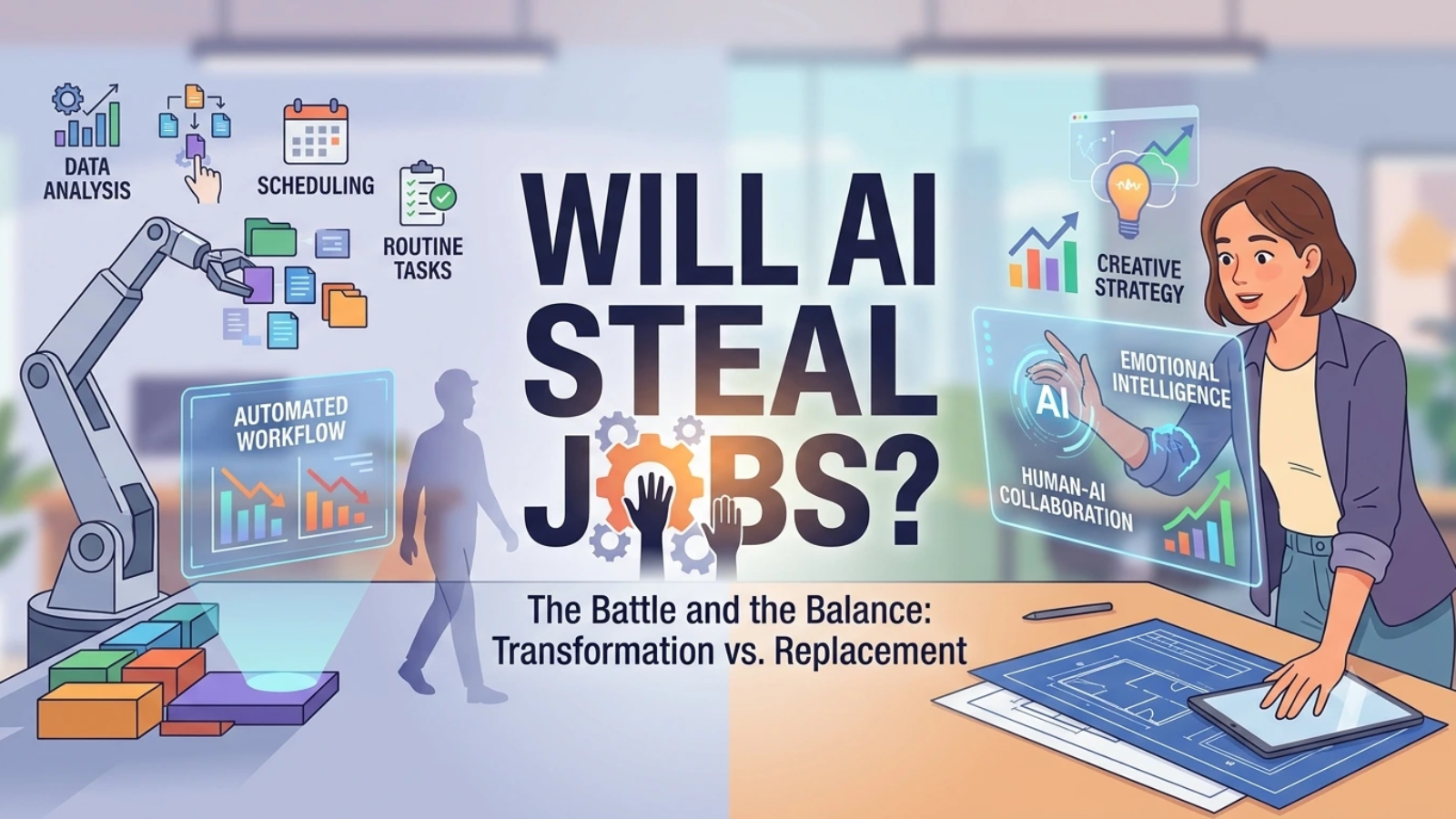
Every major technology has changed the way people work. The internet transformed communication. Smartphones changed how businesses connect with customers. Now, Artificial Intelligence (AI) is creating another major shift.
One question is becoming more common every day:
Will AI steal jobs?
Many people worry that machines will replace humans. Some believe AI will make millions of workers unemployed. Others think AI will create better careers and improve productivity.
The truth lies somewhere in the middle.
AI is already changing how businesses operate. Think of it as the ultimate teammate: it can draft your emails, sort through complex data, and chat with customers. It’s even stepping into the medical world to help doctors spot diseases early. These improvements save time and reduce repetitive work.
However, AI cannot replace every human skill. Creativity, emotional intelligence, leadership, and strategic thinking remain difficult for machines to copy.
Instead of asking whether AI will completely replace people, a better question is:
How can people work alongside AI to build better careers?
We’re diving into how AI is rewriting the rules of the workplace. We’ll map out the jobs facing the biggest shifts and talk about why updating your toolkit isn’t just smart anymore—it’s essential.
What Is Artificial Intelligence?
When we talk about Artificial Intelligence (AI), we’re talking about computers that can think and learn. Instead of just following rigid code, these systems handle tasks that used to strictly require human smarts.
These tasks include:
- Learning from data
- Solving problems
- Recognizing images
- Understanding language
- Writing content
- Predicting outcomes
- Making recommendations
Unlike traditional software, AI improves over time by analyzing large amounts of information.
For example:
When you watch movies on a streaming platform, AI recommends what to watch next.
When you shop online, AI suggests products you may like.
When you use a chatbot on a website, AI helps answer your questions instantly.
Today, businesses across almost every industry use AI to improve efficiency and reduce manual work.
Why Are People Worried About AI Replacing Jobs?
The fear isn’t new.
Throughout history, automation has replaced certain types of work.
Factories introduced machines that reduced manual labor.
Banks installed ATMs.
Retail stores introduced self-checkout systems.
Each innovation changed employment, but it also created new opportunities.
AI is different because it can perform not only physical tasks but also many knowledge-based activities.
For example, AI can now:
- Draft marketing content
- Translate languages
- Analyze spreadsheets
- Create presentations
- Write computer code
- Answer customer inquiries
- Summarize long documents
As AI becomes more capable, many workers wonder if their jobs are safe.
This concern is understandable.
If software can complete the same task in seconds, companies may choose automation to reduce costs.
However, replacing a task does not always mean replacing an entire job.
Most professions involve multiple responsibilities. AI may automate some tasks, while humans continue handling the work that requires judgment, creativity, and communication.
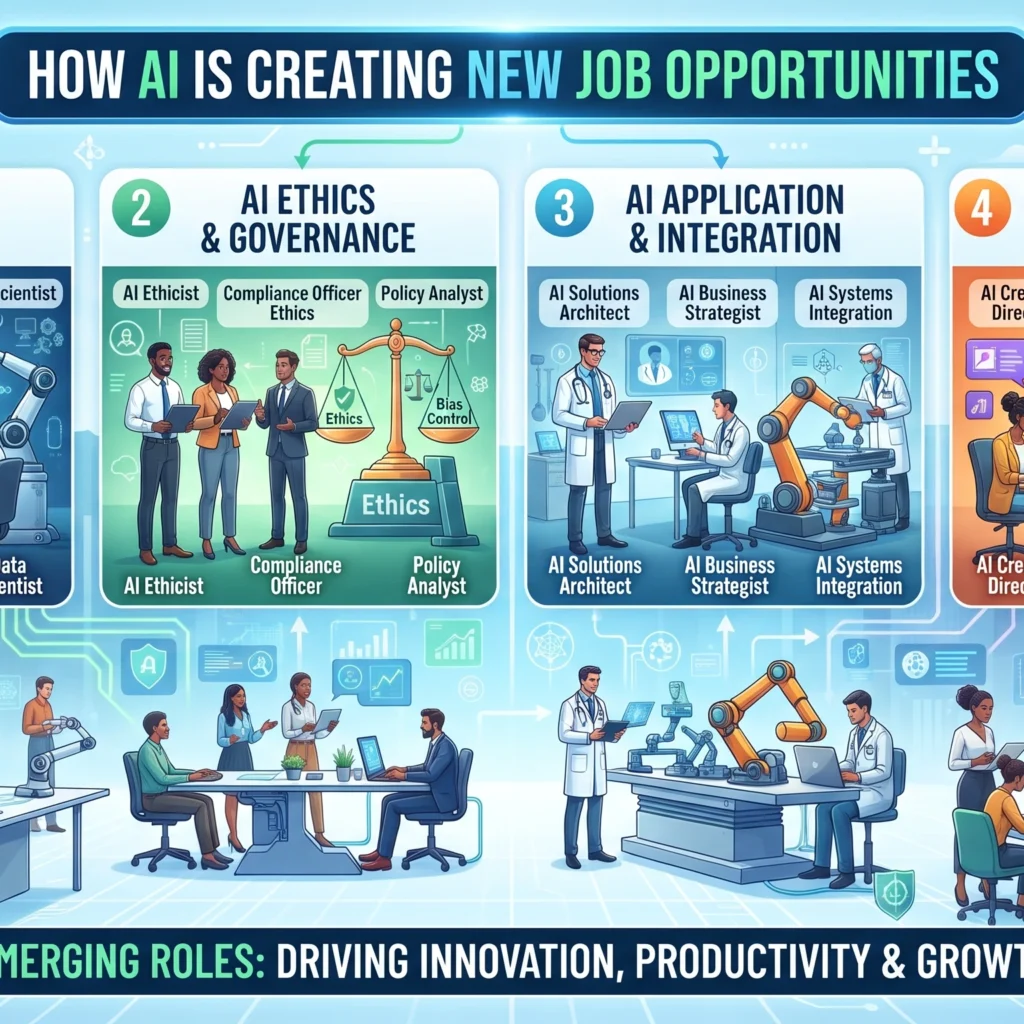
Table of Contents
Which Jobs Are Most Likely to Be Affected by AI?
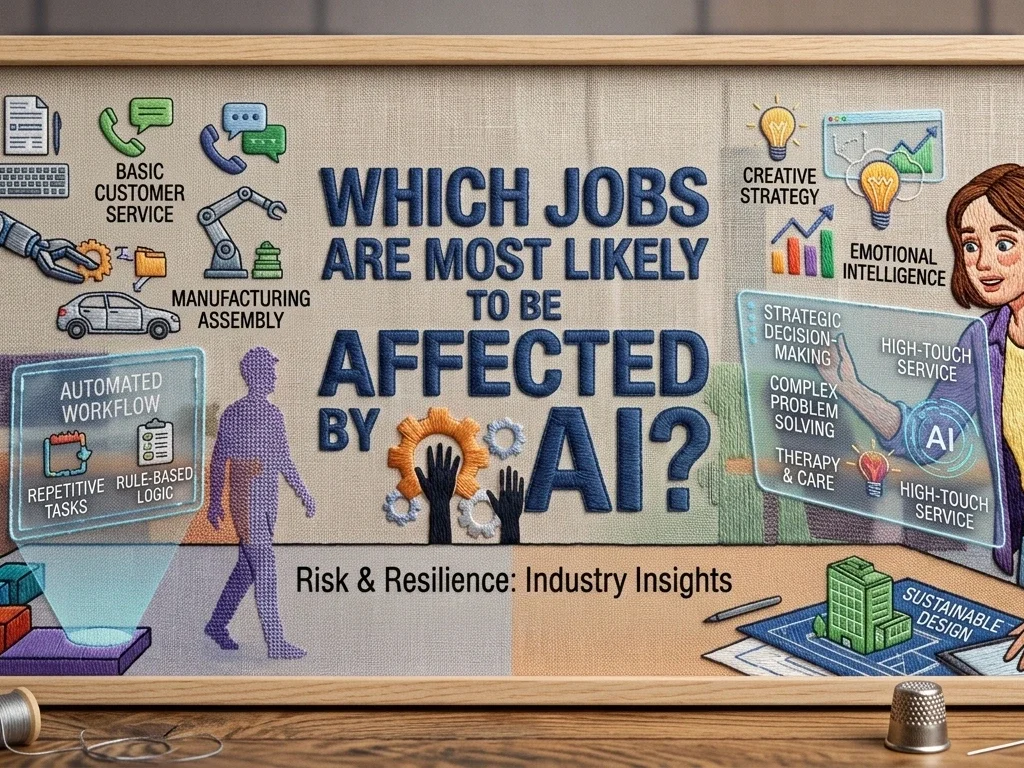
Not every profession faces the same level of risk.
Jobs that involve repetitive and predictable tasks are generally more vulnerable.
Administrative Support
Many administrative tasks can now be completed by AI.
Examples include:
- Scheduling meetings
- Organizing calendars
- Managing emails
- Creating reports
- Data entry
Instead of replacing office workers entirely, AI often helps them finish these tasks much faster.
Customer Support
AI-powered chatbots can answer frequently asked questions 24 hours a day.
Simple customer requests can now be resolved without waiting for a human representative.
Let’s face it: when a tough situation pops up, it takes empathy, real negotiation, and messy problem-solving to fix it. That’s something a piece of software just can’t copy.
Content Creation
AI can generate blog outlines, product descriptions, and social media captions in seconds.
But publishing high-quality content still requires:
- Research
- Fact-checking
- Brand voice
- Storytelling
- SEO strategy
- Audience understanding
This is why skilled content writers and digital marketers continue to play an important role.
AI works best as an assistant, not as a replacement for experienced professionals.
Manufacturing
Manufacturing has used automation for decades.
Today, AI-powered robots can improve quality control, predict equipment failures, and optimize production.
Workers increasingly supervise intelligent systems instead of performing repetitive manual tasks.
This shift creates demand for employees with technical and analytical skills.
What AI Still Cannot Replace
Despite rapid progress, AI has clear limitations.
It cannot truly understand human emotions.
It lacks personal experience.
It cannot build genuine relationships.
Most importantly, AI depends on human guidance.
Professionals who combine industry expertise with AI tools often produce better results than AI working alone.
This is why the future of work is unlikely to be humans versus AI.
Instead, it will increasingly become humans working with AI.
Jobs AI Cannot Easily Replace
If you’ve been wondering, “Will AI steal jobs?”, it’s equally important to ask another question:
Which jobs need human skills that AI can’t copy?
While AI is becoming smarter every day, it still lacks qualities that make humans unique. It cannot truly understand emotions, build trust, or think creatively in the same way people do.
Let’s look at some careers that are expected to remain valuable in the age of AI.
Healthcare Professionals
AI can analyze medical images, organize patient records, and even suggest possible diagnoses. These tools help doctors work more efficiently.
However, patients don’t only need accurate diagnoses. They also need empathy, reassurance, and personalized care.
Think about a doctor reassuring a nervous family, or a nurse helping a patient get back on their feet. Those moments require real human connection—something AI just can’t match.
Healthcare professionals will continue to use AI as a tool, not as a replacement.
Teachers and Trainers
AI can explain concepts, generate lesson plans, and answer questions instantly.
But education is about much more than sharing information.
A truly great teacher knows how to connect with every kid in the room. They don’t just hand out answers; they spark curiosity, challenge students to think deeper, and make them feel like they can handle anything.
Human interaction plays a major role in learning. This is why teachers will remain essential, even as AI becomes a regular part of the classroom.
Leaders and Managers
Business leaders make decisions based on experience, company culture, ethics, and long-term vision.
AI is fantastic at crunching numbers and predicting trends, but it can’t sit down with a struggling team and rally them. It definitely can’t step into a heated office disagreement and resolve it with actual empathy.
At the end of the day, great companies aren’t run by software—they’re run by people. You still need managers who know how to actually talk to their teams, untangle messy problems, and keep everyone steady when things change.
Creative Professionals
Many people believe AI will completely replace writers, designers, and marketers.
The reality is more balanced.
AI can give you the raw concepts, but humans give them a soul. Genuine creativity requires a deep understanding of people, culture, and the art of storytelling—things software just can’t replicate.
AI isn’t stealing the spotlight from designers and marketers; it’s giving them a faster engine. It handles the heavy lifting so human imagination can do the real driving.
Businesses still need original ideas that connect with real customers.
How AI Is Creating New Job Opportunities
Technology has always changed the job market.
When computers became common, many traditional jobs disappeared. At the same time, entirely new careers emerged, including web developers, digital marketers, cybersecurity specialists, and app developers.
AI is following the same pattern.
Instead of only replacing jobs, AI is creating demand for new skills and new professions.
Some of the fastest-growing AI-related careers include:
- AI Prompt Engineer
- Machine Learning Engineer
- AI Product Manager
- Data Scientist
- AI Ethics Consultant
- Automation Specialist
- AI Trainer
- Business Intelligence Analyst
Many traditional roles are also evolving.
For example, digital marketers now use AI to analyze customer behavior, create content ideas, optimize advertising campaigns, and improve SEO strategies.
Rather than eliminating marketing jobs, AI allows professionals to focus on strategy, creativity, and business growth.
AI Is Changing the Way We Work
One important point often gets overlooked in the discussion about AI replacing jobs.
AI usually automates tasks, not complete professions.
For example, a marketing manager performs many responsibilities every day.
These may include:
- Planning campaigns
- Meeting clients
- Managing budgets
- Analyzing performance
- Creating reports
- Leading a team
- Solving unexpected challenges
AI can help generate reports or summarize campaign data.
But let’s be honest: software can’t map out a long-term business strategy, and it definitely can’t jump on a call to build a real relationship with a client. That still takes a human touch.
The same applies to accountants, engineers, lawyers, HR professionals, and many other careers.
Their routine work may become faster, but their expertise remains valuable.
The Biggest Advantage of AI in the Workplace
Instead of viewing AI as a threat, many companies see it as a productivity partner.
Businesses use AI to save time, reduce repetitive work, and improve decision-making.
Some common business benefits include:
Faster Decision-Making
AI can analyze thousands of records within seconds.
Data gives managers the full story in a fraction of the time. They get the insights they need right away, making it way easier to make the right call on the fly.
Improved Customer Experience
Many companies now use AI-powered chatbots to answer basic customer questions around the clock.
This reduces waiting time while allowing customer service teams to focus on more complex issues.
Customers receive faster support, and businesses improve efficiency.
Better Marketing Performance
Digital marketing has changed dramatically because of AI.
Modern marketers use AI to:
- Generate keyword ideas
- Improve SEO content
- Analyze competitors
- Predict customer behavior
- Optimize advertising campaigns
- Personalize email marketing
- Create social media content
However, successful campaigns still depend on human creativity, audience understanding, and strategic planning.
AI provides recommendations, but marketers make the final decisions.
The Future Belongs to People Who Learn AI
History shows that people who adapt to new technology usually have better career opportunities.
The same is true today.
Learning how to use AI does not require becoming a software engineer.
Many professionals already use AI tools to improve their daily work.
For example:
- Writers use AI for brainstorming.
- Designers use AI for quick mockups.
- Accountants automate repetitive calculations.
- Customer support teams handle routine inquiries more efficiently.
- Business owners analyze sales data faster.
The goal isn’t to compete against AI.
The goal is to become better by using AI wisely.
The ultimate career insurance? Pairing hard technical skills with human traits like creativity and communication. If you can bridge that gap, you’ll never be out of a job.
How to Prepare Your Career for the AI Era
Instead of asking, “Will AI steal jobs?”, ask yourself a more practical question:
“How can I stay valuable in a world where AI is everywhere?”
The good news is that you don’t need to become an AI engineer to succeed. What matters most is your willingness to learn and adapt.
Here are some practical ways to prepare for the future.
Learn How to Use AI Tools
AI tools are becoming part of everyday work. Whether you’re a marketer, teacher, accountant, designer, or business owner, learning to use AI can improve your productivity.
Start by exploring tools that fit your profession. Use them to automate repetitive tasks, organize information, or generate ideas. Remember, AI works best when guided by human knowledge and experience.
Strengthen Human Skills
Technical skills are important, but human skills will become even more valuable.
Focus on developing:
- Communication
- Leadership
- Critical thinking
- Creativity
- Emotional intelligence
- Problem-solving
- Decision-making
These abilities are difficult for AI to replicate and will continue to be highly valued by employers.
Commit to Continuous Learning
Technology changes quickly, and the workplace changes with it.
Take online courses, earn certifications, attend webinars, and stay updated with industry trends. Lifelong learning isn’t just an advantage anymore—it’s becoming a necessity.
Professionals who continue learning are more likely to grow their careers, even as technology evolves.
The Role of AI in Digital Marketing
Digital marketing is one of the industries experiencing the biggest transformation through AI.
Tasks that once required hours of manual work can now be completed in minutes. AI helps marketers research keywords, analyze competitors, optimize campaigns, generate content ideas, and measure performance.
However, successful digital marketing still depends on people.
At the end of the day, an SEO strategy that actually moves the needle comes down to knowing what your audience is searching for, creating things they actually want to read, and earning their trust. While AI is a killer assistant for research and saving time, it just can’t replicate your brand’s unique story or a smart, long-term marketing game plan.
At Nextbrand IT Ltd., we believe AI should empower businesses—not replace the people behind them.The goal isn’t to let AI run the show. It’s about letting the tech handle the busywork so your team has the space to think strategically, get creative, and focus on what your clients actually need.
The future belongs to organizations that know how to balance technology with human expertise.
Final Thoughts: Will AI Steal Jobs?
So, will AI steal jobs?
The answer is yes and no.
AI will automate some repetitive tasks and change the way many people work. Certain job roles may decline as automation becomes more common.
On the flip side, AI isn’t just closing doors—it’s opening brand-new ones. It’s creating entirely new roles and giving anyone willing to adapt a massive head start.
History has shown that every major technological advancement changes the job market. The people who adapt are often the ones who succeed.
Rather than fearing AI, focus on understanding it.
Learn how it works.
Use it to become more productive.
Keep improving your skills.
The future of work is not about humans versus AI.
It’s about humans working with AI to achieve better results.
You don’t need to be a tech genius to benefit from AI—you just need to be curious. Wrapping your head around these tools today is the ultimate shortcut to staying ahead of the curve, no matter your industry.
1. Will AI steal all jobs?
No. AI is expected to automate specific tasks rather than replace every job. Many careers still require creativity, communication, leadership, and emotional intelligence.
2. Which jobs are most at risk from AI?
Jobs that involve repetitive and predictable tasks, such as data entry, basic customer support, scheduling, and routine administrative work, are more likely to be affected by AI.
3. Which jobs are safe from AI?
Healthcare professionals, teachers, leaders, skilled tradespeople, therapists, creative professionals, and strategic decision-makers are less likely to be fully replaced because their work relies heavily on human interaction and judgment.
4. Can AI replace digital marketers?
AI can automate many marketing tasks, but it cannot fully replace experienced digital marketers who understand customer behavior, branding, strategy, and creative storytelling.
5. Will AI create new jobs?
Yes. AI is creating new roles such as AI specialists, prompt engineers, automation consultants, AI trainers, and data analysts. Many existing jobs are also evolving rather than disappearing.
Leave a Comment