Graphic Design

Why Your Business Needs Good Graphic Design

Many owners ask why graphic design is important for their small business. The short answer is simple. Good design helps people notice you, trust you, and remember you. In this guide, you will see how design brings more customers.

Think about the last shop you visited. The sign looked clean and bright. The menu was easy to read. You felt good before you bought anything. That is the power of design.

Design is not only about pretty pictures. It is about clear messages. When your message is clear, people understand you faster. Customers choose brands that are easy to understand.

What Is Graphic Design?

Graphic design is the art of using pictures, colors, and words to share an idea. A logo, a poster, and a social media post are all graphic design. Designers mix shapes, fonts, and photos in a smart way. The goal is to make people understand your message quickly.

You see graphic design every day. It is on food packs, bus stops, websites, and phone apps. Most of the time, you do not even think about it. But your brain notices it all.

What Is the Main Goal of Graphic Design?

If you ask what is the main goal of graphic design, the answer is simple. It is to share a message in a clear way. Good design also builds trust and pushes people to take action. For example, a clear button can make people click.

Design is not only for beauty. Beauty is a nice bonus, but clarity comes first. If people cannot understand your poster, it has failed, even if it looks nice. Always ask: “Is my message clear?”

Why Graphic Design Is Important for Every Business, Big or Small

Why graphic design is important for any business comes down to one thing. Design is how people first meet your brand. Before they read a word, they see your logo, colors, and style. In a few seconds, they decide if you look trusted.

This is true for a big company and a tiny shop. A home baker needs a nice logo and clean packs. A software firm needs a clear website and neat icons. Every business has a story, and design tells it.

Good design also makes people remember you. When your look is the same everywhere, people know you at once. They see your color and think of your brand. That is how big brands stay in our minds.

Why Is Good Design So Important?

If you wonder why is good design so important, think about trust. People judge a brand in a few seconds. A clean design says, “This business cares.” A messy design says the opposite.

Good design also helps people understand your offer. A clear price table is easier to read than a long text. A neat menu helps people choose fast. When choosing is easy, people buy more.

But be careful. Design is not magic. A beautiful ad cannot fix a weak product. Good design works best when your product, price, and service are also good.

Why Are Graphics So Important?

Why are graphics so important today? Because the brain reads pictures faster than words. A strong image can share an idea in one second. A long text may take a full minute. On a busy social media feed, speed matters.

Graphics also help people who do not read English well. A simple icon or chart can explain what words cannot. Pictures work in every language. This helps you reach more people.

Graphics also keep people on your page. A page full of text feels heavy. Photos, icons, and charts give the eyes a rest. This is one more clear sign of why graphic design is important online.

6 Reasons Why Graphic Design Is Important for Business Growth

Now let us look at the main benefits. Each one helps your business grow in a real way. Here are six clear reasons.

1. It Builds Your Brand Identity

Brand identity is how your business looks and feels. It includes your logo, colors, fonts, and style. Good design keeps all of these the same on every page and post. That is why graphic design is important for brand identity.

2. It Builds Trust

People do not trust a brand that looks messy. A blurry logo or a broken layout feels risky. A neat and clean design feels safe. This is why graphic design is important for trust, and trust leads to sales.

3. It Helps You Stand Out

Many businesses sell the same things. Your design can make you different. A unique color or a fun logo helps people pick you. This is why graphic design is important when the market is full.

4. It Brings More Sales

Good design guides the eyes of your visitors. It shows them what to read first and where to click. A clear call-to-action button can raise your sales. Small design changes can bring big results, and that shows why graphic design is important for growth.

5. It Makes Your Message Clear

Customers do not read every word. They scan. Good design uses headings, space, and images to help them scan fast. This is why graphic design is important for a clear message.

6. It Saves Money in the Long Run

Cheap designs may look cheap. Then you must pay again to fix it. A good design is made once and used for years. That is another reason why graphic design is important for your budget.

What Does Good Design Look Like in Real Life?

Imagine a small cafe in your area. The owner uses a blurry logo and five different fonts. The menu has too much text. Customers walk past without stopping, and the cafe stays quiet.

Now imagine a second cafe next door. It has a simple logo, two warm colors, and a neat menu. Its posts look the same every time. People start to know it, trust it, and visit again.

Both cafes sell the same coffee. The big difference is design. This small story shows why graphic design is important for any shop, big or small.

What Is the Difference Between Good and Bad Design?

Good design is simple, clear, and the same everywhere. Bad design is busy, hard to read, and different on every page. The table below makes it easy to see why graphic design is important to get right.

Area Good Design Bad Design 
Logo Simple and easy to know Too busy and hard to see 
Colors Two or three matching colors Too many colors 
Fonts Easy to read Hard to read or too many styles 
Photos Sharp and real Blurry or copied 
Message One clear idea Many ideas at once 

Look at your own website and posts. Count how many items match the bad column. Fix one at a time, because even small fixes help.

Which Types of Graphic Design Does a Business Need?

Most businesses need a few basic types of design. You do not need all of them on day one. Start with the ones your customers see the most.

  • Logo design: the face of your brand
  • Social media posts: they bring daily attention
  • Website and app design: they decide how easy your site is to use
  • Packaging: it makes your product look worth buying
  • Flyers and brochures: they share offers in print
  • Ads and banners: they bring in new customers

Start with a logo and social media posts. These two are seen the most. Then add website and print items as you grow.

How Does Graphic Design Help Your Website and SEO?

Good design helps your website in a few ways. Clean layouts make pages easy to use. Fast-loading images keep visitors from leaving. Clear headings help both people and search engines read your page.

Be careful about one thing. Google does not rank a page only because it looks pretty. But a page that is easy to read and use keeps visitors longer. This is one more reason why graphic design is important for SEO.

Many people visit websites on their phones. So your design must work on small screens. Text should be big, and buttons should be easy to tap. This is also why graphic design is important for mobile users.

Images need care too. Use small file sizes so your page loads fast. Add alt text, which is a short line that describes the image. Alt text helps search engines and people who use screen readers.

What Are Common Graphic Design Mistakes?

Many small businesses make the same mistakes. The good news is that they are easy to fix. Check this list before you post anything.

  • Using too many fonts or colors
  • Writing too much text on one image
  • Using blurry or low-quality photos
  • Copying another brand’s logo or style
  • Changing the look on every post
  • Using light text on a light background

Most of these mistakes come from rushing. Take a little more time to check your work. Ask a friend what your image says in five seconds. If they cannot tell, make it simpler.

How Can a Small Business Start With Good Design?

Many owners ask why graphic design is important when money is tight. The answer is that a clear look helps you win trust early. You can start small and still look professional. Follow these steps.

  1. Pick two or three brand colors.
  2. Choose one or two easy-to-read fonts.
  3. Make a simple logo that works in small sizes.
  4. Use the same style on all posts and pages.
  5. Ask a professional designer to help with key items like your logo.

Free tools can help you start. But a professional designer brings skill and fresh ideas. If money is tight, pay for a good logo and use templates for the rest. This is a smart way to grow step by step.

Frequently Asked Questions About Graphic Design (FAQs)

1. What is the main goal of graphic design?

The main goal of graphic design is to share a message in a clear way. It also helps build trust and move people to act. Beauty matters, but clarity comes first.

2. Is graphic design worth it for a small business?

Yes, it is. Why graphic design is important for a small business is easy to see. It helps you look trusted and stand out from others. A small shop with a clean look can win against a bigger brand.

3. Does graphic design help SEO?

Yes, but not directly. Clean layouts and fast images help people stay longer on your page. Alt text helps search engines understand your images. Good design supports SEO, but it does not replace good content.

4. Can graphic design increase sales?

Graphic design can support sales by making products easier to understand and marketing messages more appealing. However, design alone cannot guarantee higher sales. Product quality, pricing, customer service, and marketing strategy also matter.

5. Why is good design so important for customers?

Good design helps customers find information, understand offers, and use websites more easily. Clear and consistent visuals can also make a business appear more professional.

Final Thoughts: Why Graphic Design Is Important for Your Business

Now you know why graphic design is important. It builds trust, makes your message clear, and helps people remember you. It also supports your website, ads, and sales. Good design is not a cost. It is an investment.

Your customers may never say, “Nice design.” But they will feel it. They will trust you faster and stay longer. That is why graphic design is important, even when no one talks about it.

Remember, design works best with a good product and honest service. Start small, stay simple, and keep your look the same. Over time, your brand will grow stronger.

Need help with your brand design? Talk to the NextBrand IT team today. We can help you build a clean and strong look for your business.
How Much Does SEO Cost

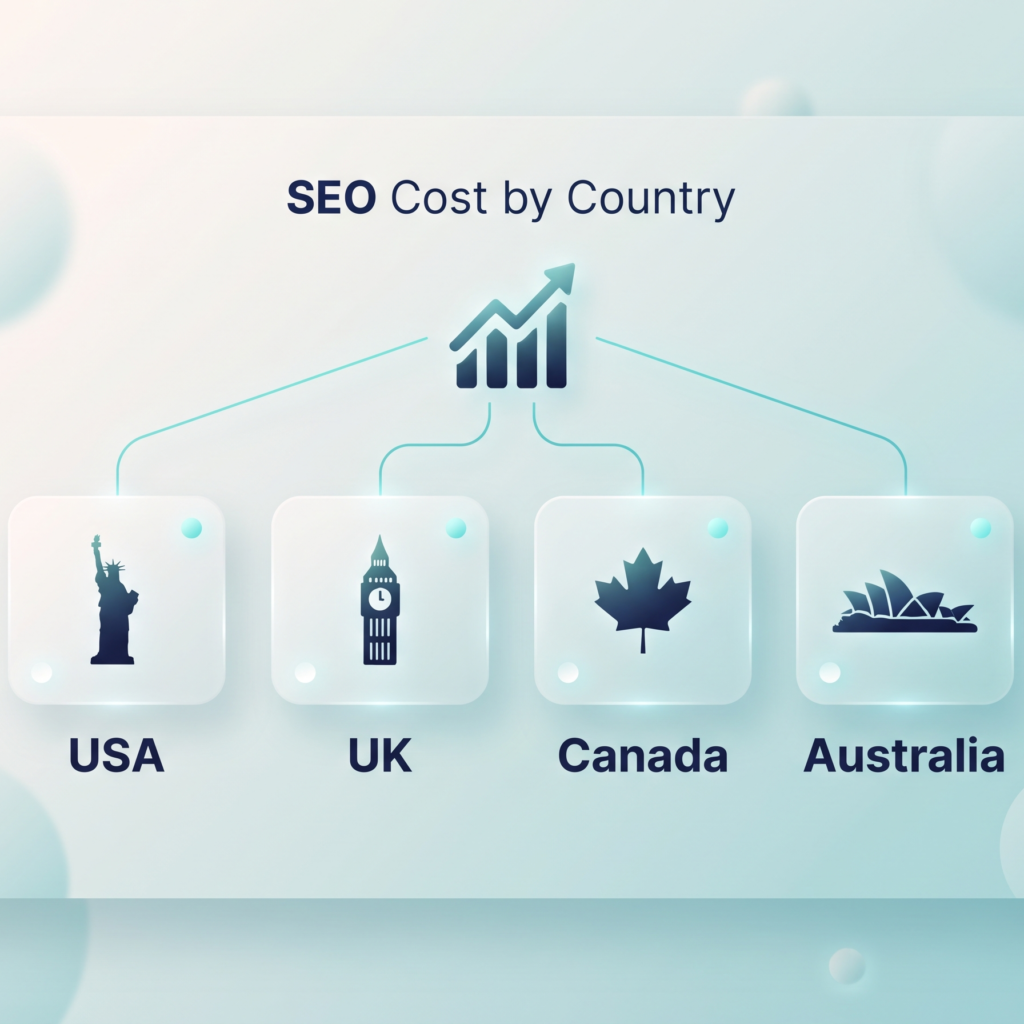
How Much Does SEO Cost in 2026? (USD, GBP, AUD, CAD Compared)

“How much does SEO cost?” Ask five agencies and you’ll probably get five different numbers — $500, $1,500, $3,000, $8,000, sometimes more. It’s not that four of them are lying. It’s that “SEO” can mean a dozen different things depending on who’s selling it, and nobody bothers explaining what’s actually behind the number.

We’re not going to do that to you here. This guide pulls from real 2026 industry pricing surveys — not guesswork — and breaks the numbers down by business size, service scope, and country, so you walk away with an actual budget range instead of more confusion.

Quick answer: Most small businesses pay between $750 and $3,000 USD per month for SEO in 2026, with the industry-wide average sitting closer to $2,900–$3,200/month once agencies of every size are factored in. Local, low-competition SEO tends to land at the lower end; national or highly competitive campaigns push well past $5,000/month.

How Much Does SEO Cost? A Quick Answer

Let’s get the number out of the way first, because that’s what you actually came here for.

Across a 2026 survey of 439 SEO providers, the average cost of SEO sits around $2,917 a month — agencies alone average closer to $3,209/month, while freelancers come in lower at around $1,348/month. But averages are misleading here, because they blend tiny freelance setups with $15,000/month enterprise campaigns into one number. A separate 2026 survey found a very different picture: roughly 64% of agencies actually charge under $1,000 a month, which tells you the market is far more split between “budget” and “premium” than a single average suggests.

The number that matters more for most small businesses: $750–$3,000 a month is where a legitimate, results-focused SEO package typically lands, according to multiple 2026 pricing surveys. Anything significantly below that range is worth questioning — not because cheap SEO is impossible, but because it usually means very limited scope, not a bargain.

What Affects SEO Pricing?

A handful of factors explain almost all of the spread between a $750/month quote and an $8,000/month quote:

  • Industry competitiveness — ranking a local bakery is a very different job from ranking a national law firm or SaaS company
  • Geographic scope — targeting one city costs less than targeting an entire country (and considerably less than multiple countries)
  • Content requirements — sites needing dozens of new pages or ongoing content production cost more than sites needing light optimization
  • Experience level of the provider — SEO professionals with 5–10 years of experience typically charge more than double the rate of someone with under two years, and that gap generally reflects real differences in strategy and results
  • What’s included — technical SEO, content, link building, and reporting all add cost; a $500/month quote almost certainly doesn’t include all four

SEO Cost Per Month: Pricing Models Explained

Before comparing numbers, it helps to understand how SEO is actually sold — because the “seo cost per month” question assumes a monthly retainer, but that’s only one of three common models.

Monthly Retainer vs Project-Based vs Hourly: Which Is Best?

Pricing ModelHow It WorksBest For
Monthly RetainerFixed monthly fee for ongoing work (technical SEO, content, link building, reporting)Businesses treating SEO as a core, ongoing growth channel
Project-BasedOne-time fee for a defined deliverable (site migration, technical audit, content overhaul)Businesses needing a specific fix, not ongoing management
Hourly ConsultingPay per hour for strategy or advisory workBusinesses with an in-house team that needs occasional expert guidance

Monthly retainers are by far the most common model for small businesses, and for good reason: SEO is a compounding investment. Rankings built over six consistent months rarely come from a single one-off project — they come from steady, ongoing execution. Most agencies will tell you the same thing we tell our clients: budget for at least 6 months before expecting meaningful traction, regardless of which pricing model you choose.

Small Business SEO Packages: What’s Typically Included

“Small business seo packages” usually get sold in tiers, and understanding what’s actually inside each tier matters more than the price tag alone.

What’s Usually Included in a Small Business SEO Package

  • Keyword research — identifying what your customers are actually searching for
  • On-page optimization — titles, meta descriptions, headers, internal linking, site structure
  • Technical SEO — site speed, mobile usability, indexing issues, schema markup
  • Content creation — blog posts, service pages, or landing pages built around target keywords
  • Link building — earning backlinks from relevant, credible sites
  • Monthly reporting — rankings, traffic, and progress toward agreed goals

A package priced under $500/month almost never includes all six of these — it’s usually limited to basic on-page tweaks and light reporting, with content and link building excluded or billed separately. That’s not automatically a bad deal, but it needs to match what you actually need. A local service business with low competition might genuinely be fine with a lighter package; a business trying to rank nationally almost certainly isn’t.

SEO Pricing by Country

Pricing shifts meaningfully depending on which market you’re in — competition level, average business size, and typical agency overhead all vary by country.

SEO Cost in the USA (USD)

The US has the most competitive SEO market of the four, which shows in the numbers: small businesses typically budget $1,500–$3,000/month for real movement, while local, low-competition campaigns can start around $500–$1,500/month. National or highly competitive campaigns frequently run $3,000–$10,000+/month, with local SEO specifically averaging around $1,557/month versus $3,474/month for national campaigns.

SEO Cost in the UK (GBP)

UK SEO pricing tends to track slightly below equivalent US pricing once converted, largely due to a smaller, more geographically concentrated market. Small businesses typically budget £600–£2,500/month, with national campaigns in competitive industries (finance, legal, insurance) running higher.

SEO Cost in Canada (CAD)

Canadian SEO pricing sits close to US pricing, generally landing around $1,000–$3,500 CAD/month for small to mid-sized businesses. Bilingual campaigns (English/French, particularly for businesses targeting Quebec) typically cost more, since content and keyword research effectively need to be done twice.

SEO Cost in Australia (AUD)

Australian SEO pricing generally runs $1,200–$4,000 AUD/month for small businesses, with local, city-based campaigns at the lower end and national campaigns higher. Agencies working across time zones — including international providers like Next Brand IT — can often offer competitive pricing without sacrificing communication quality.

Quick Comparison Table

CountrySmall Business Range (Monthly)National/Competitive Range
USA$1,500 – $3,000 USD$3,000 – $10,000+ USD
UK£600 – £2,500 GBP£2,500 – £8,000+ GBP
Canada$1,000 – $3,500 CAD$3,500 – $10,000+ CAD
Australia$1,200 – $4,000 AUD$4,000 – $12,000+ AUD
seo marketing cost

Hidden Costs to Watch For

Beyond the headline monthly number, a few line items tend to catch businesses off guard after they’ve already signed a contract. Worth asking about upfront:

Content production fees. Some agencies quote a low base retainer, then bill content creation separately — a blog post or landing page can add $150–$500 per piece on top of the “package” price. If content is central to your strategy (and for most businesses, it should be), ask whether it’s included or itemized separately before comparing quotes.How to Choose the Best SEO Agency for Your Budget

Link building add-ons. Link building is one of the most labor-intensive parts of SEO, and it’s also one of the first things cut from budget packages. Some providers charge per-link or per-outreach-campaign on top of the base retainer — worth clarifying exactly how many links per month, if any, are included.

Technical SEO audits and fixes. A one-time technical audit is sometimes priced separately from ongoing monthly work, particularly for older websites with accumulated technical debt. If your site hasn’t had SEO work done before, budget for this as a likely upfront cost rather than assuming it’s bundled in.

Tool and software costs. Some smaller providers pass along the cost of SEO tools (rank tracking, keyword research platforms, technical auditing software) as a separate line item. Larger agencies typically absorb this into their retainer, but it’s worth a direct question.

AI search optimization (GEO/AEO). This is a newer cost category in 2026 — optimizing content so it gets surfaced correctly inside AI Overviews, ChatGPT, and other answer engines. Many agencies now charge for this separately, averaging around $900+/month on top of traditional SEO, since it requires a different content structure and technical approach than classic search optimization.

None of these are red flags on their own — separately itemized pricing can actually be more transparent than an all-in-one number that hides how the budget is allocated. The goal is simply knowing what you’re paying for before the invoice arrives, not after.

How to Choose the Best SEO Agency for Your Budget

Finding the best seo agency isn’t about finding the cheapest one — it’s about finding the one whose pricing matches their scope, and whose scope matches your actual goals.

Signs You’ve Found the Best SEO Agency for Your Business

  • They explain exactly what’s included in their pricing, without vague “custom strategy” language that avoids specifics
  • They ask about your business before quoting a price — competitive analysis matters more than a flat rate card
  • They set realistic timelines — anyone promising first-page rankings in 30 days is either inexperienced or not being straight with you
  • They report on real metrics — rankings, organic traffic, and leads/conversions, not just “activity completed”
  • Their pricing sits within known market ranges — wildly below or dramatically above the ranges in this guide is worth a second look, not necessarily a dealbreaker, but a reason to ask more questions

Cheap SEO vs Expensive SEO: What’s the Real Difference?

best seo agency

The honest answer: it’s rarely about the number itself, and almost always about what’s excluded at a lower price point.

A $300/month package and a $3,000/month package aren’t the same service at different prices — they’re usually different services entirely. The cheaper option typically skips content creation, does minimal or no link building, and relies on basic on-page tweaks that plateau quickly. The more expensive option usually includes ongoing content, deliberate link building, and technical work that compounds over time.

That doesn’t mean the most expensive agency automatically wins, either. Enterprise-priced agencies sometimes carry overhead that has little to do with your specific results. The real question isn’t “cheap or expensive” — it’s whether the scope of work matches your competitive reality. A local business with light competition can genuinely succeed with a modest budget. A business trying to outrank national competitors on a $400/month package is set up to be disappointed no matter how good the agency is.

Is SEO Worth the Investment?

For most businesses, yes — and the ROI math is a big part of why. Digital marketing broadly returns roughly $5 for every $1 spent on average, and SEO specifically tends to compound in a way paid ads don’t: once a page ranks well, it keeps generating traffic without an ongoing per-click cost, unlike Google Ads or Meta Ads, where traffic stops the moment the budget does.

The trade-off is time. SEO isn’t a same-week result — most businesses need 4–6 months before seeing meaningful ranking movement, and longer in competitive industries. Businesses that need leads immediately often run paid ads alongside SEO in the early months, then shift budget toward organic as rankings mature.

SEO vs Paid Ads: A Cost Comparison Over Time

TimeframeSEO Cost & ResultPaid Ads Cost & Result
Month 1–3Ongoing monthly cost, minimal traffic yetOngoing spend, immediate traffic while budget runs
Month 4–6Rankings start climbing, organic traffic beginsSame spend required to maintain traffic
Month 7–12Traffic compounds, often surpassing early ad traffic at lower marginal costTraffic remains flat relative to spend; stops entirely if budget pauses
Year 2+Continued organic traffic, often at a lower cost-per-lead than any paid channelCost-per-lead stays roughly constant; total spend keeps climbing

This is the core argument for treating SEO as a long-term budget line rather than a short-term campaign: the businesses that stop and restart SEO every few months rarely see the compounding effect that makes the investment worthwhile in the first place. Consistency matters more than raw budget size — a modest, steady $1,000/month for 12 months typically outperforms a $5,000/month burst that gets cancelled after two.

Why Choose Next Brand IT

At Next Brand IT, we price SEO the way we’d want it priced if we were the ones buying it: transparent scope, no hidden fees, and packages that actually match what a small or mid-sized business needs to compete — not an inflated enterprise rate card applied to every client regardless of size.

What that looks like in practice:

  • Clear, upfront pricing — you’ll know exactly what’s included before you commit to anything
  • Packages built around your actual competition, not a one-size-fits-all tier
  • Multi-country experience across the US, UK, Canada, and Australia, so pricing reflects real market knowledge, not a flat global rate
  • Monthly reporting tied to rankings, traffic, and leads — not just a list of completed tasks

Want a real number instead of a range? Get a free, custom SEO quote from Next Brand IT based on your industry, market, and goals — no generic package, no pressure.

Frequently Asked Questions

How much does SEO cost per month?

Most small businesses pay between $750 and $3,000 USD per month for a legitimate SEO package, with the broader industry average sitting around $2,900–$3,200/month once larger agencies are factored in. Local, low-competition campaigns tend to land at the lower end of that range.

Is SEO worth the investment for small businesses?

For most small businesses, yes. Digital marketing returns an average of roughly $5 for every $1 spent, and unlike paid ads, SEO traffic continues after the initial investment rather than stopping the moment a budget runs out.

What factors affect SEO pricing?

Industry competitiveness, geographic targeting scope, content requirements, provider experience level, and exactly what’s included (technical SEO, content, link building, reporting) all affect the final price.

Is cheap SEO worth it?

It depends on your competitive landscape. A local business with light competition can succeed with a modest budget. A business trying to compete nationally on a very low budget is usually paying for a scope of work too limited to produce meaningful results.

Do SEO agencies charge hourly or monthly?

Most ongoing SEO work is billed as a monthly retainer, since SEO requires consistent execution over time. Hourly billing is more common for advisory or consulting work, and project-based pricing is typically used for one-time deliverables like a technical audit or site migration.

How much should I budget for SEO in 2026?

As a starting point, budget $750–$3,000/month if you’re a small business in the US, UK, Canada, or Australia, and expect the number to rise with industry competitiveness or if you’re targeting more than one country at once.

Final Thoughts

There’s no single honest answer to “how much does SEO cost” — but there is an honest range, and now you have it. What matters more than the exact number is matching the scope of work to your actual competitive situation, and working with a provider who explains clearly what that number includes.

If you’d rather skip the ranges and get an actual quote for your business, talk to Next Brand IT — we’ll walk you through pricing based on your market and goals, not a generic rate card.

Local SEO vs International SEO: Which Fits You?

Local SEO vs International SEO: Which Fits You?

If you’ve ever typed “local seo vs international seo” into Google trying to figure out which one your business actually needs, you’re not alone. It’s one of the most common questions business owners ask when they start taking search visibility seriously — and honestly, it’s a fair question. The two approaches share the same end goal (getting found on Google), but the strategies, tools, and even the mindset behind them are quite different.

Maybe you run a single-location dental clinic in Manchester. Or maybe you’re scaling an e-commerce brand that ships to the US, UK, Canada, and Australia all at once. Either way, picking the wrong SEO approach can waste months of effort and budget chasing rankings that don’t actually move your business forward.

In this guide, we’ll break down what local SEO and international SEO actually mean, how they differ, and — most importantly — how to figure out which one (or both) your business needs right now. By the end, you’ll have a clear picture, plus practical checklists you can start using today.

local seo strategy

What Is Local SEO?

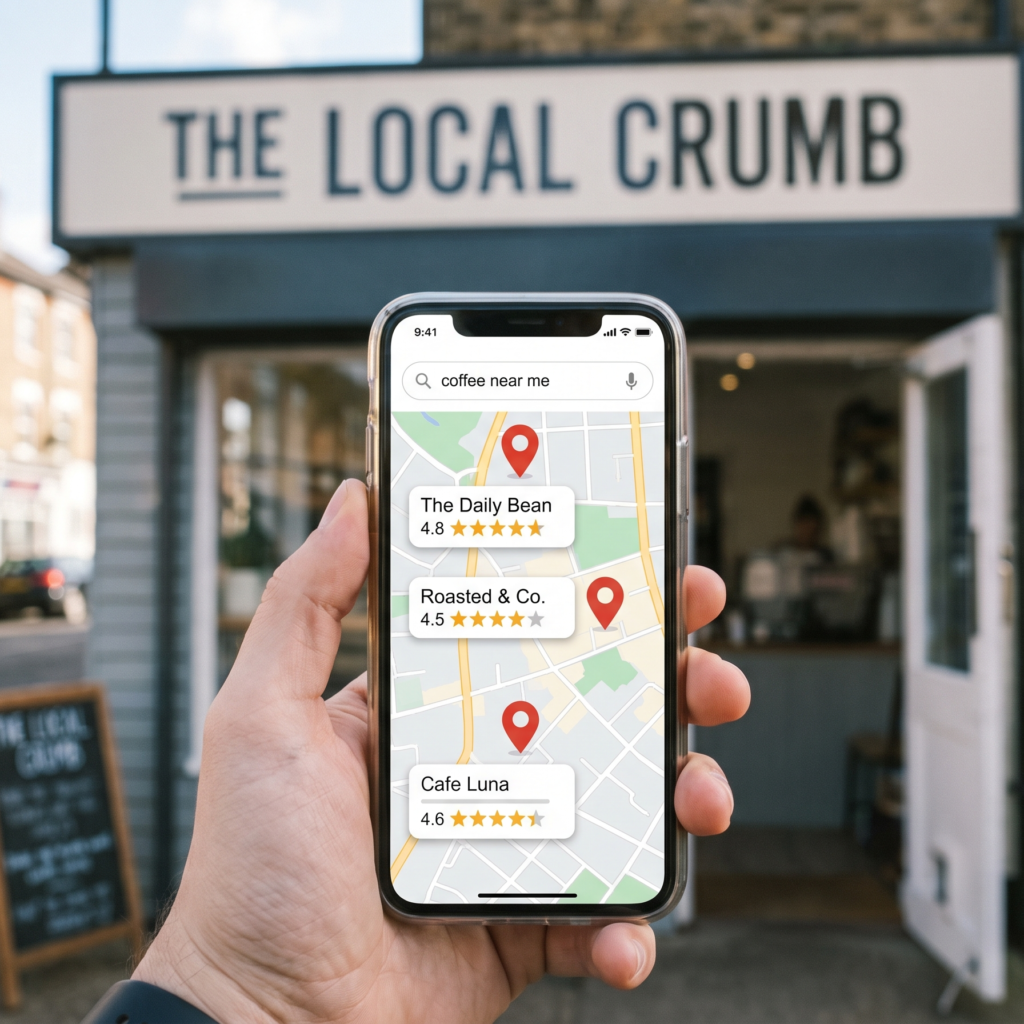
Local SEO is the practice of optimizing your online presence so your business shows up when people search for products or services near a specific location — usually a city, town, or region. Think “plumber near me,” “best coffee shop in Leeds,” or “dentist in Toronto.” Google uses signals like your business address, customer reviews, and local citations to decide who deserves to show up in that map pack and those local results.

Unlike broader SEO efforts, local SEO isn’t really about competing on a national or global scale. It’s about being the obvious, trusted choice for people who are physically close to you or who need a service delivered in your area.

Who Needs Local SEO?

Local SEO is essential for any business that depends on foot traffic or serves customers within a defined geographic area. Some clear examples include:

  • Restaurants and cafés that rely on nearby diners finding them
  • Medical clinics and dental practices where patients search for care close to home
  • Plumbers, electricians, and other home service providers who only work within a certain radius
  • Retail stores with a physical storefront
  • Law firms, salons, gyms, and real estate agents who serve a specific city or metro area

Basically, if a customer needs to physically visit you, or you need to physically go to them, local SEO should be at the center of your strategy.

What Is International SEO?

International SEO, on the other hand, is about making your website visible and relevant to audiences across multiple countries or language markets. It’s not just about ranking — it’s about making sure Google understands which version of your site to show to which audience, and that your content actually resonates with each market’s language, currency, and search habits.

This involves technical elements like hreflang tags, country-specific URL structures, and localized content — plus a strategic approach to keyword research that accounts for how people search differently across regions, even when they’re speaking the same language.

Who Needs International SEO?

International SEO becomes necessary once your business operations, sales, or audience cross national borders. Common examples include:

  • E-commerce brands shipping products to multiple countries
  • SaaS companies with customers signing up from all over the world
  • B2B service providers pitching to clients in different regions
  • Franchises or agencies with offices or partners in multiple countries
  • Content publishers targeting readers in different English-speaking (or multilingual) markets

If your growth plan involves reaching customers outside your home country, international SEO isn’t optional — it’s the foundation that makes that expansion actually work in search.

Local SEO vs Global SEO: Core Differences

When people compare local seo vs global seo, the confusion usually comes from thinking they’re just “smaller” and “bigger” versions of the same thing. In reality, they solve different problems and require different toolkits entirely.

Local SEO is built around proximity and trust signals within one market. Global (international) SEO is built around technical infrastructure and content strategy that scales across markets. One is about depth in a single location; the other is about breadth across many.

Key Differences at a Glance

FactorLocal SEOInternational SEO
Targeting ScopeSingle city, region, or metro areaMultiple countries or language markets
Technical SetupGoogle Business Profile, local schema markupHreflang tags, ccTLD/subdirectory structure, geotargeting in Search Console
Content StrategyLocation-specific pages, local keywordsCountry-specific content, currency & language localization
Link BuildingLocal citations, local news, community partnershipsRegion-based backlinks, international PR, market-specific outreach
CostGenerally lower — narrower scopeHigher — more markets, more content, more technical work
Timeline to ResultsOften faster (weeks to a few months)Longer (several months per market, sometimes longer)

The takeaway: local SEO tends to be more contained and quicker to show movement, while international SEO is a bigger, longer-term investment that pays off through wider market reach.

Building a Local SEO Strategy

A strong local seo strategy is built on a handful of core pillars that work together to build trust with both Google and local customers.

Core Elements of an Effective Local SEO Strategy

Google Business Profile Optimization Your Google Business Profile (formerly Google My Business) is arguably the single most important local ranking factor. Complete every field — categories, hours, services, photos — and keep it updated. An incomplete or outdated profile signals low trust to both Google and potential customers.

Local Citations Citations are mentions of your business name, address, and phone number (NAP) across directories like Yelp, Yellow Pages, and industry-specific listings. Consistency across all of these builds credibility and helps Google confirm your business is legitimate and active.

Location-Based Keywords Instead of just targeting broad terms like “accountant,” local businesses need to target phrases like “small business accountant in Bristol” or “tax advisor near [neighborhood].” These location-modified keywords match how people actually search when they want something nearby.

Reviews Management Customer reviews influence both rankings and conversion rates. Actively encouraging reviews — and responding to them, positive or negative — shows Google (and future customers) that your business is engaged and trustworthy.

Together, these elements create a local footprint that’s hard for competitors to outrank, especially when maintained consistently over time.

Local SEO Checklist

If you want a practical starting point, here’s a local seo checklist you can work through step by step:

  1. Set up and fully complete your Google Business Profile — categories, hours, photos, description, and services
  2. Ensure NAP consistency (Name, Address, Phone) across your website and every directory listing
  3. Do local keyword research — identify city, neighborhood, and “near me” search terms relevant to your services
  4. Create city or region-specific landing pages if you serve multiple areas, each with unique, locally relevant content
  5. Build local backlinks and citations through local business associations, chambers of commerce, and community sponsorships
  6. Develop a customer review strategy — ask satisfied customers for reviews and respond promptly to all feedback
  7. Add local business schema markup to your website so search engines can clearly read your location data
  8. Monitor local rankings using rank-tracking tools focused on your target city or region

Working through this checklist consistently — not just once — is what separates businesses that dominate local search from those that plateau after initial setup.

International SEO Checklist

For businesses expanding across borders, here’s an international seo checklist to guide the technical and strategic setup:

  1. Set up hreflang tags correctly so Google serves the right language/country version of your pages to the right audience
  2. Conduct international keyword research per country — search behavior and terminology often differ even between English-speaking markets (e.g., “trainers” in the UK vs. “sneakers” in the US)
  3. Decide on your URL structure — ccTLD (.co.uk, .ca), subdirectory (/uk/, /ca/), or subdomain (uk.example.com), each with different SEO and maintenance trade-offs
  4. Create country-specific content rather than simply translating — pricing, currency, cultural references, and examples should reflect each market
  5. Build region-based backlinks from local publications, directories, and partners within each target country
  6. Set up per-country performance reporting in Google Search Console and analytics tools to track rankings and traffic by market separately
  7. Localize technical elements like currency, date formats, shipping information, and legal/compliance content per country
  8. Test site speed and hosting performance for users in each target region, using CDNs where necessary

Skipping the technical foundation — especially hreflang and URL structure — is the most common reason international SEO campaigns underperform, even when the content itself is solid.

international seo checklist

Country-Specific Considerations

SEO isn’t one-size-fits-all, even within what looks like a single “market.” Here’s how local vs international SEO plays out differently across four key regions.

Local vs International SEO for US Businesses

The US is large enough that “local” often means state or even city-specific targeting rather than treating the whole country as one market. A business operating in multiple states can face challenges that resemble international SEO — different competitors, different search behavior, and sometimes different regulations — even though it’s technically one country.

Local vs International SEO for UK Businesses

Being a smaller, more geographically compact country makes local SEO relatively straightforward for UK businesses. However, once a business looks to expand into the EU or Ireland, it starts needing international SEO practices — different currencies, VAT considerations, and language nuances come into play even with English-speaking neighbors like Ireland.

Local vs International SEO for Canadian Businesses

Canada adds a unique layer: bilingual considerations. Serving English and French-speaking audiences within the same country requires a strategy that’s closer to “mini-international” SEO — separate content, careful hreflang setup between en-CA and fr-CA, and distinct keyword research for each language segment.

Local vs International SEO for Australian Businesses

Australia’s vast geography paired with lower population density means city-based local SEO remains a strong strategy for most businesses — Sydney, Melbourne, and Brisbane function almost like separate markets. But businesses looking to expand into New Zealand will need to start applying international SEO principles, despite the geographic and cultural closeness.

Can You Do Both at the Same Time?

Yes — and for many growing businesses, a hybrid approach is exactly the right move. A business might maintain strong local SEO for its physical stores or service areas in the US while simultaneously building out international SEO to support expansion into the UK or Canada.

The key is not treating these as competing priorities, but as complementary layers of the same overall visibility strategy. Local SEO protects and strengthens your home turf, while international SEO opens doors to new markets — and done well, they can even reinforce each other through shared brand authority and cross-market backlinks.

At Next Brand IT, we regularly manage both sides of this equation for clients — running focused local campaigns for physical locations while building out the technical and content infrastructure needed for international growth, all under one coordinated strategy rather than two disconnected efforts.

How to Decide Which One Your Business Needs

If you’re still unsure, here’s a simple framework to help you decide:

  • Do you have a physical location that customers visit, or do you serve a defined local area? → You need Local SEO
  • Do you ship products or offer services to customers in multiple countries? → You need International SEO
  • Both of the above apply to you? → You need a Hybrid Strategy that combines local depth with international reach

This isn’t always a permanent decision, either. Many businesses start local and grow into international SEO as they expand — the important thing is recognizing where you are right now so you’re not investing in the wrong strategy too early, or missing the moment when it’s time to expand.

Why Choose Next Brand IT

Whether your business needs sharp local visibility, a full international SEO rollout, or both running side by side, Next Brand IT builds strategies around where your business actually is — not a generic template. We offer flexible packages for local businesses just getting serious about search, as well as comprehensive international SEO services for companies ready to scale across the US, UK, Canada, Australia, and beyond.

Not Sure Which One You Need? Get a Free SEO Consultation — our team will assess your current setup and recommend the right path forward, with no pressure and no guesswork.

Frequently Asked Questions

What is the difference between local SEO and international SEO?

Local SEO focuses on ranking within a specific city or region, relying on signals like Google Business Profile and local citations. International SEO focuses on ranking across multiple countries, relying on technical setup like hreflang tags and country-specific content.

Do I need local SEO or international SEO for my business?

It depends on how you serve customers. If you rely on a physical location or serve a specific area, local SEO is essential. If you sell to or serve customers in multiple countries, international SEO is the priority.

Can a business use both local and international SEO together?

Yes. Many businesses run a hybrid strategy — maintaining strong local visibility in their home market while building out international SEO for expansion into new countries.

Which is more expensive: local SEO or international SEO?

International SEO generally requires a larger investment due to the added technical work, multi-market content creation, and region-specific link building involved. Local SEO tends to be more affordable since it targets a single area.

How do I know if my business is ready for international SEO?

Signs of readiness include existing demand from international customers, plans to ship or operate in new countries, and the resources to create localized content and manage multi-region technical SEO.

Is local SEO enough for a small business?

For most small businesses serving a single city or region, yes — a strong local SEO strategy is often enough to drive consistent, qualified traffic without the added complexity of international SEO.

Conclusion

At the end of the day, the local seo vs international seo decision comes down to one question: where do your actual customers come from? If they’re walking through your door or calling from across town, local SEO deserves your full attention. If they’re spread across the US, UK, Canada, and Australia, international SEO is what will actually move the needle.

And if you’re somewhere in between — growing locally while eyeing new markets — a hybrid strategy lets you build both at once, without one holding back the other.

Not sure which path fits your business best? Reach out to Next Brand IT for a free SEO consultation, and we’ll help you map out a strategy that matches exactly where your business is today — and where you want it to go next.

International SEO Services: What to Expect in 2026

International SEO Services: What to Expect in 2026

A business that ranks well at home doesn’t automatically rank anywhere else. The moment a company starts selling into the US, UK, Canada, and Australia at the same time, local SEO tactics stop being enough — search behavior, competition, and even spelling conventions shift from one market to the next. This is where international seo services come in.

At Next Brand IT, we help growing businesses build a single, coordinated SEO strategy that performs across multiple English-speaking markets at once — without duplicating work four times over. This guide covers what international SEO actually involves in 2026, what a global seo strategy needs technically, what it costs, and how to choose the right seo services provider for a multi-country expansion.

Quick answer: International SEO is the process of optimizing a website so it ranks in search results across multiple countries and, where relevant, multiple languages — combining technical setup (like hreflang tags), localized keyword research, and region-specific content and link building.

What Is International SEO?

International SEO extends standard SEO practice to work across borders. Instead of optimizing for a single country’s search results, it optimizes a website to rank correctly in each target country’s version of Google — while avoiding duplicate content penalties and making sure UK users see UK-relevant pages instead of US ones (and vice versa).

This matters more than most businesses assume. Google now holds close to 90% of the global search market, and the SEO services market itself has grown into a $100+ billion industry in 2026 — a sign of just how central organic search has become to how businesses expand internationally.

Local SEO vs. International SEO: Key Differences

FactorLocal SEOInternational SEO
Targeting scopeSingle city/countryMultiple countries and/or languages
Technical setupStandard on-page SEOHreflang tags, URL structure, geo-targeting
Keyword researchOne market’s search behaviorPer-market research (spelling, terminology, intent)
Content strategySingle content calendarLocalized/adapted content per region
Link buildingLocal citations & directoriesRegion-specific domains & directories
global seo strategy

What Does a Global SEO Strategy Actually Include?

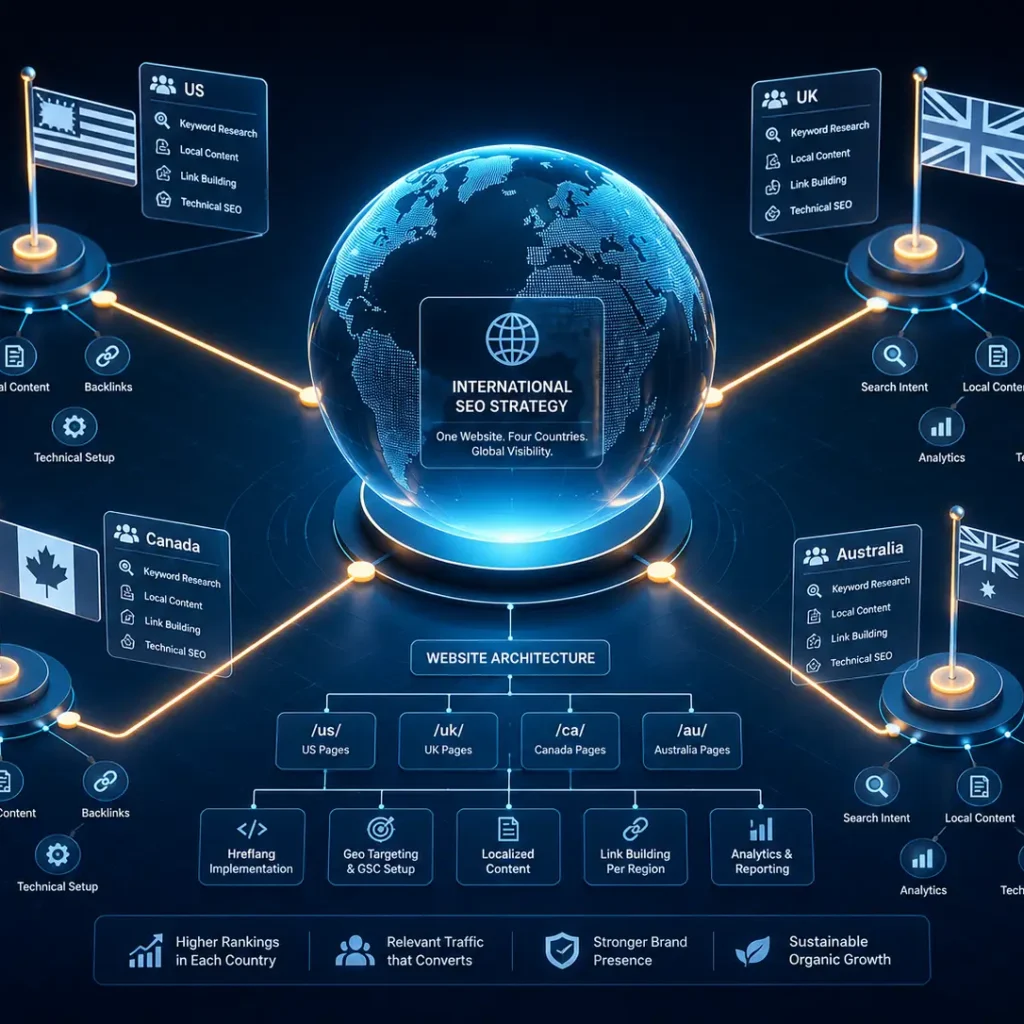
A proper global seo strategy isn’t just “translate the website and hope for the best.” It’s built on five core pillars that work together:

  1. Market & Competitor Research — understanding search demand and competition separately in each target country
  2. Technical Setup — hreflang tags, URL structure, and international targeting in Google Search Console
  3. Keyword Localization — adapting keywords for spelling, terminology, and search intent differences between markets
  4. Content Adaptation — not just translation, but rewriting content to match local tone, currency, and examples
  5. Region-Specific Link Building — earning backlinks from domains relevant to each target country

Choosing Your International SEO Structure: ccTLD vs. Subdirectory vs. Subdomain

StructureExampleProsCons
ccTLDnextbrandit.co.ukStrongest geo-signal, highest local trustMost expensive to maintain, separate domain authority per country
Subdirectorynextbrandit.com/uk/Shares domain authority, easiest to manageSlightly weaker geo-signal than ccTLD
Subdomainuk.nextbrandit.comSome separation for regional teamsOften treated as a semi-separate site by Google

For most small and mid-sized businesses targeting the US, UK, Canada, and Australia, a subdirectory structure offers the best balance — it consolidates domain authority into one site while still allowing country-specific pages.

Common International SEO Mistakes Businesses Make

Before hiring a provider or attempting international SEO in-house, it’s worth understanding where most multi-country campaigns go wrong. These patterns show up consistently across businesses expanding into the US, UK, Canada, and Australia:

1. Treating translation as localization. Simply translating or re-spelling US content for a UK audience (“optimization” to “optimisation”) isn’t the same as localizing it. Currency, examples, cultural references, and even the tone that resonates with each market need to be adapted — not just the spelling.

2. Launching all markets at once with a stretched budget. Attempting to fully localize and rank in four countries simultaneously with a budget suited for one market usually means every market gets a shallow, under-resourced effort. A phased rollout — starting with one or two priority markets — almost always outperforms an all-at-once approach with the same total budget.

3. Ignoring hreflang until something breaks. Hreflang errors are largely invisible until they start suppressing rankings — a business might not notice for months that Google is showing the wrong country’s page to a segment of its audience. Auditing hreflang implementation should happen at setup, not as a reaction to a traffic drop.

4. Duplicating content across country pages without differentiation. Near-identical content across US, UK, Canada, and Australia pages, differentiated only by spelling, gives Google very little reason to treat them as distinct, locally relevant pages — and can trigger duplicate content issues that suppress all versions rather than just one.

5. Measuring performance with one blended metric. A campaign might look successful overall while one or two markets are actually underperforming and dragging down the average. Per-country reporting isn’t a nice-to-have in international SEO — without it, it’s impossible to know where the strategy is actually working.

6. Underestimating the timeline. International SEO compounds the same way domestic SEO does, but across more variables. Multilingual and multi-market SEO efforts typically need 12-18 months before newer markets reach a meaningful share of total organic traffic — businesses expecting UK or Australian results as fast as their established US rankings are often setting themselves up for disappointment.

Avoiding these six mistakes is often the difference between an international SEO campaign that compounds successfully and one that quietly stalls in two of its four target markets.

Why Businesses Hire an International SEO Agency

Running international SEO in-house is possible, but it’s rarely efficient. An international seo agency brings a few advantages that are hard to replicate internally:

  • Speed of execution — an experienced team can set up hreflang, country targeting, and localized content calendars in weeks, not months
  • Market-specific search knowledge — understanding how UK searchers phrase queries differently from US searchers isn’t guesswork, it’s pattern recognition built from working across markets
  • Avoiding costly technical mistakes — a Semrush audit of 20,000 multilingual websites found that 58% had internal hreflang conflicts and 37% had broken hreflang links, both of which can quietly suppress rankings for months before anyone notices
  • Parallel execution across markets — instead of sequentially tackling the US, then UK, then Canada, an agency can run all four markets simultaneously

The businesses that struggle most with international SEO aren’t the ones with small budgets — they’re the ones trying to manage four markets’ worth of technical and content work with a team built for one.

International SEO Agency

Technical Foundations: Hreflang, Geo-Targeting & Site Structure

This is the part of international SEO most businesses get wrong — and where an experienced provider adds the most value.

Hreflang tags tell Google which version of a page to show to which audience (for example, en-us vs en-gb vs en-ca vs en-au). Done incorrectly, hreflang errors can cause the wrong country’s page to rank in the wrong search results, or cause Google to treat near-duplicate content as a ranking problem instead of an intentional localization.

Geo-targeting in Google Search Console lets a business signal which country a specific section of the site is meant for — useful when using a subdirectory structure like nextbrandit.com/uk/.

Site speed and Core Web Vitals also need to be evaluated per region, not just at headquarters. A site that loads quickly for US visitors can behave very differently for UK or Australian visitors depending on server location and CDN configuration — which is why serving international traffic through a properly configured CDN matters as much as the content itself.

Country-specific XML sitemaps help search engines prioritize crawling the right pages for the right market, rather than relying entirely on internal linking to signal importance.

International Keyword Research & Content Localization

Keyword research for international SEO isn’t a translation exercise — it’s a research exercise repeated per market. The same product or service can be searched for using entirely different terms depending on the country.

Keyword Research for Multiple English-Speaking Markets (US vs UK vs Canada vs Australia)

Even across English-speaking countries, search behavior varies more than most businesses expect:

  • Spelling differences: “optimization” (US/Canada) vs “optimisation” (UK/Australia); “color” vs “colour”
  • Terminology differences: “vacation” (US) vs “holiday” (UK/Australia); “apartment” (US) vs “flat” (UK)
  • Commercial terms: pricing searches often include local currency terms — “cost in USD” vs “cost in GBP” vs “cost in AUD”
  • Search intent shifts: the same keyword can carry different intent in different markets depending on local competition and buying habits

Roughly 70% of global search queries are non-English, and worldwide language preference plays a measurable role even within English-speaking regions — research shows the majority of online shoppers prefer buying in language and terminology that feels native to them. For a business targeting US, UK, Canada, and Australia simultaneously, this means keyword research has to be run four times, not once.

International SEO for the USA

The US remains the largest and most competitive English-speaking search market, and North America alone accounts for roughly a third of global SEO services revenue. Businesses targeting the US need to balance broad national keywords with city or state-level local SEO, especially for service-based businesses competing against well-established local players.

International SEO for the UK

UK SEO carries a few distinctions worth planning for early: deciding between a .co.uk domain or a subdirectory on a .com, adjusting spelling and terminology (optimisation, colour, favourite), and factoring in GDPR when setting up analytics and tracking for UK visitors. UK search behavior also tends to favor detailed, information-first content over aggressively sales-oriented pages.

International SEO for Canada

Canada’s bilingual market — particularly the English/French split concentrated in Quebec — adds a layer international SEO strategies for other markets don’t need to account for. Businesses serious about the Canadian market often need separate English and French content tracks, along with city-based targeting for major markets like Toronto, Vancouver, and Montreal.

International SEO for Australia

Australia’s search market rewards strong local SEO fundamentals — Google Business Profile optimization, local directory citations, and suburb-level keyword targeting — combined with standard national SEO for broader visibility. Time zone alignment also matters operationally: agencies able to offer coverage that overlaps with Australian business hours tend to execute campaigns and resolve issues faster.

How Much Does International SEO Cost?

Seo marketing cost for international campaigns is typically higher than single-market SEO, simply because the work multiplies per country — separate keyword research, separate content calendars, and separate technical audits.

ScopeTypical Monthly RangeNotes
Single-market SEO$750 – $2,500 USDOne country, one keyword set
2-country international SEO$1,500 – $4,500 USDShared technical setup, separate content/keywords
3–4 country international SEO (US, UK, Canada, Australia)$2,500 – $8,000+ USDFull localization, region-specific reporting
One-time technical audit (hreflang, structure)$500 – $2,000 USDOften a starting point before ongoing work begins

Pricing is typically structured as either a flat monthly retainer covering all target markets, or per-market packages that can be added incrementally as a business expands into new countries. For most businesses starting international SEO for the first time, launching in one or two markets and expanding once results are visible is more capital-efficient than launching all four countries simultaneously.

How to Choose the Right SEO Services Provider

Not every SEO provider that says “we do international SEO” actually has the technical depth to do it correctly. Here’s what to check before hiring a seo services provider for a multi-country campaign:

  • Ask for multi-market case studies — not just domestic results. Ranking a site in one country is a different skill set from coordinating rankings across four.
  • Confirm hreflang and technical SEO expertise specifically — this is the area most agencies get wrong, and errors here can silently suppress rankings for months.
  • Request per-country reporting — a provider should be able to show ranking and traffic performance broken out by market, not one blended number.
  • Ask about content localization process — find out whether content is truly adapted per market or simply translated.
  • Check realistic timelines — international SEO, like standard SEO, compounds over time; expect meaningful results within 4-6 months, with non-branded traffic in newer markets often taking 12+ months to mature.

Questions to Ask Before Hiring an International SEO Services Provider

  • How do you structure hreflang tags for our specific site setup?
  • Will content be localized per market, or only translated?
  • How do you report results separately by country?
  • What’s your experience with our specific target markets?
  • What’s the realistic timeline before we see ranking movement in each country?

Why Choose Next Brand IT

Next Brand IT provides international SEO services built specifically for businesses expanding across the US, UK, Canada, and Australia — without the overhead or slow turnaround of a large multinational agency.

Our approach includes:

  • Technical SEO audits covering hreflang, site structure, and international targeting setup
  • Per-market keyword research that accounts for spelling, terminology, and search intent differences across all four countries
  • Localized content strategy — not direct translation, but content adapted to how each market actually searches and buys
  • Region-specific reporting so you always know exactly how each country is performing, not just a blended average
  • Coordinated link building across country-relevant domains and directories

Because our team works across multiple time zones and markets as a core part of our service — not as an occasional project — we’re able to launch and manage multi-country SEO campaigns more efficiently than agencies built primarily around a single domestic market.

Ready to expand your organic visibility internationally? Get a free international SEO audit from Next Brand IT and see exactly where your current site stands in each target market.

Frequently Asked Questions

What is international SEO?

International SEO is the practice of optimizing a website to rank in search results across multiple countries and, where relevant, multiple languages. It combines technical setup like hreflang tags with market-specific keyword research, content localization, and regional link building.

How is international SEO different from local SEO?

Local SEO focuses on ranking within a single city or country, typically for businesses with a physical location or a single target market. International SEO expands this to multiple countries simultaneously, requiring separate technical configuration, keyword research, and content strategy for each target market.

Do I need hreflang tags for international SEO?

Yes, if you’re targeting more than one country or language with similar or overlapping content. Hreflang tags tell Google which version of a page to show to which audience, preventing duplicate content issues and ensuring the correct regional page appears in each country’s search results.

How much does international SEO cost?

Costs vary based on how many markets are targeted, but typically range from $1,500–$4,500 USD per month for two markets, up to $2,500–$8,000+ USD per month for a full four-market campaign covering the US, UK, Canada, and Australia.

How long does international SEO take to show results?

Most businesses start seeing measurable ranking movement within 4-6 months, though newer, non-branded keywords in additional markets can take 12 months or longer to mature — particularly in competitive industries.

Can one SEO strategy work across the US, UK, Canada, and Australia?

Not directly. While these countries share a language, search behavior, spelling, terminology, and competition levels differ enough that each market needs its own keyword research and, in many cases, adapted content — even if the underlying technical setup and site structure are shared.

Final Thoughts

International SEO in 2026 isn’t optional for businesses serious about growing beyond a single market — it’s the infrastructure that determines whether a US, UK, Canadian, or Australian customer can even find you in the first place. The technical details (hreflang, site structure, per-market keyword research) are unforgiving of shortcuts, which is exactly why choosing the right international seo services partner matters as much as the strategy itself.

If you’re ready to build a coordinated global seo strategy across the US, UK, Canada, and Australia, reach out to Next Brand IT for a free international SEO audit.

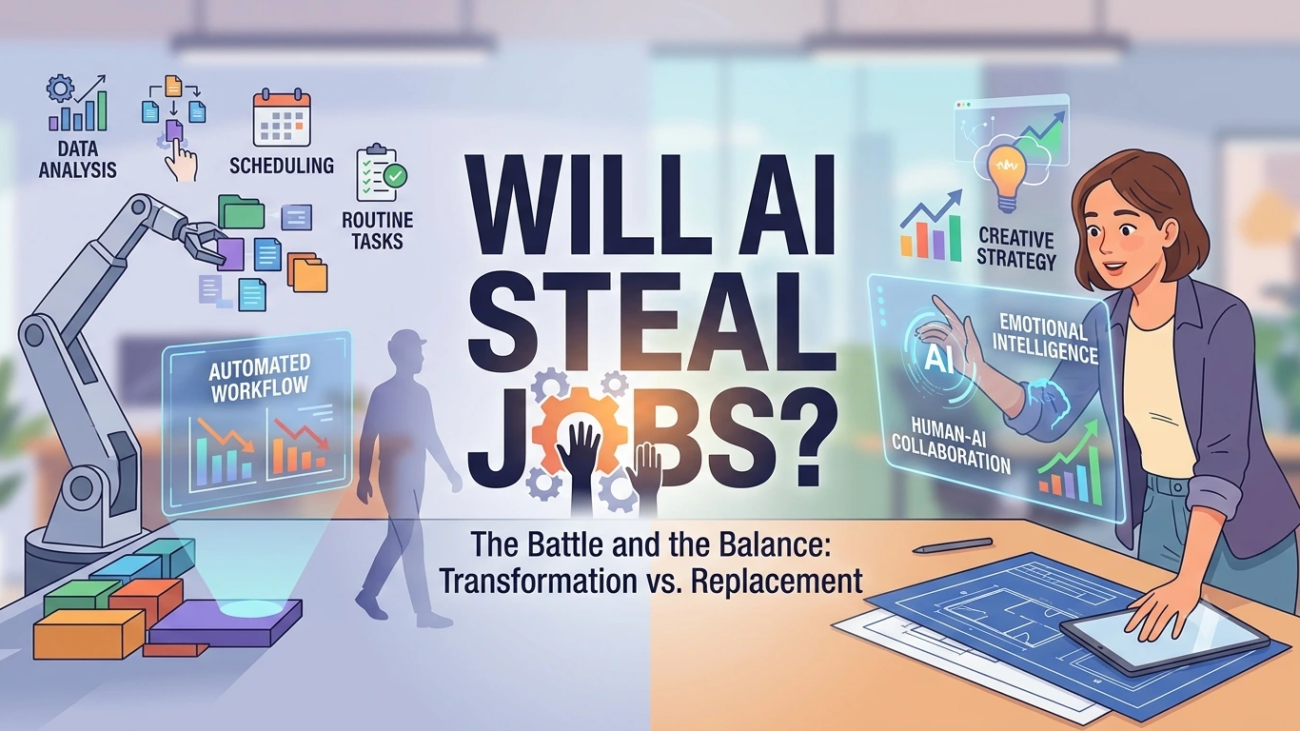
Will AI Steal Jobs

Will AI Steal Jobs? The Truth About AI and the Future of Work

Every major technology has changed the way people work. The internet transformed communication. Smartphones changed how businesses connect with customers. Now, Artificial Intelligence (AI) is creating another major shift.

One question is becoming more common every day:

Will AI steal jobs?

Many people worry that machines will replace humans. Some believe AI will make millions of workers unemployed. Others think AI will create better careers and improve productivity.

The truth lies somewhere in the middle.

AI is already changing how businesses operate. Think of it as the ultimate teammate: it can draft your emails, sort through complex data, and chat with customers. It’s even stepping into the medical world to help doctors spot diseases early. These improvements save time and reduce repetitive work.

However, AI cannot replace every human skill. Creativity, emotional intelligence, leadership, and strategic thinking remain difficult for machines to copy.

Instead of asking whether AI will completely replace people, a better question is:

How can people work alongside AI to build better careers?

We’re diving into how AI is rewriting the rules of the workplace. We’ll map out the jobs facing the biggest shifts and talk about why updating your toolkit isn’t just smart anymore—it’s essential.

What Is Artificial Intelligence?

When we talk about Artificial Intelligence (AI), we’re talking about computers that can think and learn. Instead of just following rigid code, these systems handle tasks that used to strictly require human smarts.

These tasks include:

  • Learning from data
  • Solving problems
  • Recognizing images
  • Understanding language
  • Writing content
  • Predicting outcomes
  • Making recommendations

Unlike traditional software, AI improves over time by analyzing large amounts of information.

For example:

When you watch movies on a streaming platform, AI recommends what to watch next.

When you shop online, AI suggests products you may like.

When you use a chatbot on a website, AI helps answer your questions instantly.

Today, businesses across almost every industry use AI to improve efficiency and reduce manual work.

Why Are People Worried About AI Replacing Jobs?

The fear isn’t new.

Throughout history, automation has replaced certain types of work.

Factories introduced machines that reduced manual labor.

Banks installed ATMs.

Retail stores introduced self-checkout systems.

Each innovation changed employment, but it also created new opportunities.

AI is different because it can perform not only physical tasks but also many knowledge-based activities.

For example, AI can now:

  • Draft marketing content
  • Translate languages
  • Analyze spreadsheets
  • Create presentations
  • Write computer code
  • Answer customer inquiries
  • Summarize long documents

As AI becomes more capable, many workers wonder if their jobs are safe.

This concern is understandable.

If software can complete the same task in seconds, companies may choose automation to reduce costs.

However, replacing a task does not always mean replacing an entire job.

Most professions involve multiple responsibilities. AI may automate some tasks, while humans continue handling the work that requires judgment, creativity, and communication.

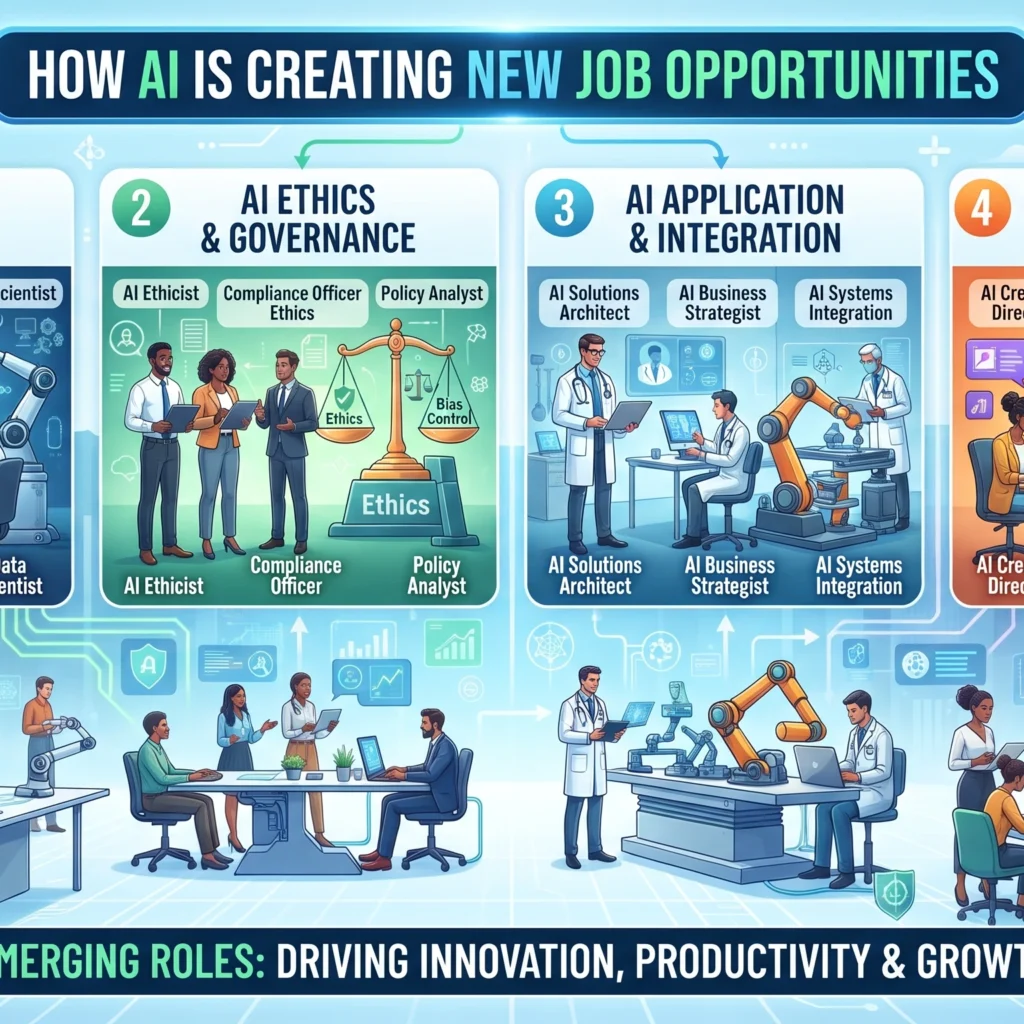
How AI Is Creating New Job Opportunities

Which Jobs Are Most Likely to Be Affected by AI?

Not every profession faces the same level of risk.

Jobs that involve repetitive and predictable tasks are generally more vulnerable.

Administrative Support

Many administrative tasks can now be completed by AI.

Examples include:

  • Scheduling meetings
  • Organizing calendars
  • Managing emails
  • Creating reports
  • Data entry

Instead of replacing office workers entirely, AI often helps them finish these tasks much faster.

Customer Support

AI-powered chatbots can answer frequently asked questions 24 hours a day.

Simple customer requests can now be resolved without waiting for a human representative.

Let’s face it: when a tough situation pops up, it takes empathy, real negotiation, and messy problem-solving to fix it. That’s something a piece of software just can’t copy.

Content Creation

AI can generate blog outlines, product descriptions, and social media captions in seconds.

But publishing high-quality content still requires:

  • Research
  • Fact-checking
  • Brand voice
  • Storytelling
  • SEO strategy
  • Audience understanding

This is why skilled content writers and digital marketers continue to play an important role.

AI works best as an assistant, not as a replacement for experienced professionals.

Manufacturing

Manufacturing has used automation for decades.

Today, AI-powered robots can improve quality control, predict equipment failures, and optimize production.

Workers increasingly supervise intelligent systems instead of performing repetitive manual tasks.

This shift creates demand for employees with technical and analytical skills.

What AI Still Cannot Replace

Despite rapid progress, AI has clear limitations.

It cannot truly understand human emotions.

It lacks personal experience.

It cannot build genuine relationships.

Most importantly, AI depends on human guidance.

Professionals who combine industry expertise with AI tools often produce better results than AI working alone.

This is why the future of work is unlikely to be humans versus AI.

Instead, it will increasingly become humans working with AI.

Jobs AI Cannot Easily Replace

If you’ve been wondering, “Will AI steal jobs?”, it’s equally important to ask another question:

Which jobs need human skills that AI can’t copy?

While AI is becoming smarter every day, it still lacks qualities that make humans unique. It cannot truly understand emotions, build trust, or think creatively in the same way people do.

Let’s look at some careers that are expected to remain valuable in the age of AI.

Healthcare Professionals

AI can analyze medical images, organize patient records, and even suggest possible diagnoses. These tools help doctors work more efficiently.

However, patients don’t only need accurate diagnoses. They also need empathy, reassurance, and personalized care.

Think about a doctor reassuring a nervous family, or a nurse helping a patient get back on their feet. Those moments require real human connection—something AI just can’t match.

Healthcare professionals will continue to use AI as a tool, not as a replacement.

Teachers and Trainers

AI can explain concepts, generate lesson plans, and answer questions instantly.

But education is about much more than sharing information.

A truly great teacher knows how to connect with every kid in the room. They don’t just hand out answers; they spark curiosity, challenge students to think deeper, and make them feel like they can handle anything.

Human interaction plays a major role in learning. This is why teachers will remain essential, even as AI becomes a regular part of the classroom.

Leaders and Managers

Business leaders make decisions based on experience, company culture, ethics, and long-term vision.

AI is fantastic at crunching numbers and predicting trends, but it can’t sit down with a struggling team and rally them. It definitely can’t step into a heated office disagreement and resolve it with actual empathy.

At the end of the day, great companies aren’t run by software—they’re run by people. You still need managers who know how to actually talk to their teams, untangle messy problems, and keep everyone steady when things change.

Creative Professionals

Many people believe AI will completely replace writers, designers, and marketers.

The reality is more balanced.

AI can give you the raw concepts, but humans give them a soul. Genuine creativity requires a deep understanding of people, culture, and the art of storytelling—things software just can’t replicate.

AI isn’t stealing the spotlight from designers and marketers; it’s giving them a faster engine. It handles the heavy lifting so human imagination can do the real driving.

Businesses still need original ideas that connect with real customers.

How AI Is Creating New Job Opportunities

Technology has always changed the job market.

When computers became common, many traditional jobs disappeared. At the same time, entirely new careers emerged, including web developers, digital marketers, cybersecurity specialists, and app developers.

AI is following the same pattern.

Instead of only replacing jobs, AI is creating demand for new skills and new professions.

Some of the fastest-growing AI-related careers include:

  • AI Prompt Engineer
  • Machine Learning Engineer
  • AI Product Manager
  • Data Scientist
  • AI Ethics Consultant
  • Automation Specialist
  • AI Trainer
  • Business Intelligence Analyst

Many traditional roles are also evolving.

For example, digital marketers now use AI to analyze customer behavior, create content ideas, optimize advertising campaigns, and improve SEO strategies.

Rather than eliminating marketing jobs, AI allows professionals to focus on strategy, creativity, and business growth.

AI Is Changing the Way We Work

One important point often gets overlooked in the discussion about AI replacing jobs.

AI usually automates tasks, not complete professions.

For example, a marketing manager performs many responsibilities every day.

These may include:

  • Planning campaigns
  • Meeting clients
  • Managing budgets
  • Analyzing performance
  • Creating reports
  • Leading a team
  • Solving unexpected challenges

AI can help generate reports or summarize campaign data.

But let’s be honest: software can’t map out a long-term business strategy, and it definitely can’t jump on a call to build a real relationship with a client. That still takes a human touch.

The same applies to accountants, engineers, lawyers, HR professionals, and many other careers.

Their routine work may become faster, but their expertise remains valuable.

The Biggest Advantage of AI in the Workplace

Instead of viewing AI as a threat, many companies see it as a productivity partner.

Businesses use AI to save time, reduce repetitive work, and improve decision-making.

Some common business benefits include:

Faster Decision-Making

AI can analyze thousands of records within seconds.

Data gives managers the full story in a fraction of the time. They get the insights they need right away, making it way easier to make the right call on the fly.

Improved Customer Experience

Many companies now use AI-powered chatbots to answer basic customer questions around the clock.

This reduces waiting time while allowing customer service teams to focus on more complex issues.

Customers receive faster support, and businesses improve efficiency.

Better Marketing Performance

Digital marketing has changed dramatically because of AI.

Modern marketers use AI to:

  • Generate keyword ideas
  • Improve SEO content
  • Analyze competitors
  • Predict customer behavior
  • Optimize advertising campaigns
  • Personalize email marketing
  • Create social media content

However, successful campaigns still depend on human creativity, audience understanding, and strategic planning.

AI provides recommendations, but marketers make the final decisions.

Why Are People Worried About AI Replacing Jobs

The Future Belongs to People Who Learn AI

History shows that people who adapt to new technology usually have better career opportunities.

The same is true today.

Learning how to use AI does not require becoming a software engineer.

Many professionals already use AI tools to improve their daily work.

For example:

  • Writers use AI for brainstorming.
  • Designers use AI for quick mockups.
  • Accountants automate repetitive calculations.
  • Customer support teams handle routine inquiries more efficiently.
  • Business owners analyze sales data faster.

The goal isn’t to compete against AI.

The goal is to become better by using AI wisely.

The ultimate career insurance? Pairing hard technical skills with human traits like creativity and communication. If you can bridge that gap, you’ll never be out of a job.

How to Prepare Your Career for the AI Era

Instead of asking, “Will AI steal jobs?”, ask yourself a more practical question:

“How can I stay valuable in a world where AI is everywhere?”

The good news is that you don’t need to become an AI engineer to succeed. What matters most is your willingness to learn and adapt.

Here are some practical ways to prepare for the future.

Learn How to Use AI Tools

AI tools are becoming part of everyday work. Whether you’re a marketer, teacher, accountant, designer, or business owner, learning to use AI can improve your productivity.

Start by exploring tools that fit your profession. Use them to automate repetitive tasks, organize information, or generate ideas. Remember, AI works best when guided by human knowledge and experience.

Strengthen Human Skills

Technical skills are important, but human skills will become even more valuable.

Focus on developing:

  • Communication
  • Leadership
  • Critical thinking
  • Creativity
  • Emotional intelligence
  • Problem-solving
  • Decision-making

These abilities are difficult for AI to replicate and will continue to be highly valued by employers.

Commit to Continuous Learning

Technology changes quickly, and the workplace changes with it.

Take online courses, earn certifications, attend webinars, and stay updated with industry trends. Lifelong learning isn’t just an advantage anymore—it’s becoming a necessity.

Professionals who continue learning are more likely to grow their careers, even as technology evolves.

The Role of AI in Digital Marketing

Digital marketing is one of the industries experiencing the biggest transformation through AI.

Tasks that once required hours of manual work can now be completed in minutes. AI helps marketers research keywords, analyze competitors, optimize campaigns, generate content ideas, and measure performance.

However, successful digital marketing still depends on people.

At the end of the day, an SEO strategy that actually moves the needle comes down to knowing what your audience is searching for, creating things they actually want to read, and earning their trust. While AI is a killer assistant for research and saving time, it just can’t replicate your brand’s unique story or a smart, long-term marketing game plan.

At Nextbrand IT Ltd., we believe AI should empower businesses—not replace the people behind them.The goal isn’t to let AI run the show. It’s about letting the tech handle the busywork so your team has the space to think strategically, get creative, and focus on what your clients actually need.

The future belongs to organizations that know how to balance technology with human expertise.

Final Thoughts: Will AI Steal Jobs?

So, will AI steal jobs?

The answer is yes and no.

AI will automate some repetitive tasks and change the way many people work. Certain job roles may decline as automation becomes more common.

On the flip side, AI isn’t just closing doors—it’s opening brand-new ones. It’s creating entirely new roles and giving anyone willing to adapt a massive head start.

History has shown that every major technological advancement changes the job market. The people who adapt are often the ones who succeed.

Rather than fearing AI, focus on understanding it.

Learn how it works.

Use it to become more productive.

Keep improving your skills.

The future of work is not about humans versus AI.

It’s about humans working with AI to achieve better results.

You don’t need to be a tech genius to benefit from AI—you just need to be curious. Wrapping your head around these tools today is the ultimate shortcut to staying ahead of the curve, no matter your industry.

1. Will AI steal all jobs?

No. AI is expected to automate specific tasks rather than replace every job. Many careers still require creativity, communication, leadership, and emotional intelligence.

2. Which jobs are most at risk from AI?

Jobs that involve repetitive and predictable tasks, such as data entry, basic customer support, scheduling, and routine administrative work, are more likely to be affected by AI.

3. Which jobs are safe from AI?

Healthcare professionals, teachers, leaders, skilled tradespeople, therapists, creative professionals, and strategic decision-makers are less likely to be fully replaced because their work relies heavily on human interaction and judgment.

4. Can AI replace digital marketers?

AI can automate many marketing tasks, but it cannot fully replace experienced digital marketers who understand customer behavior, branding, strategy, and creative storytelling.

5. Will AI create new jobs?

Yes. AI is creating new roles such as AI specialists, prompt engineers, automation consultants, AI trainers, and data analysts. Many existing jobs are also evolving rather than disappearing.

google ad management agency

Google Ad Management Agency: Boost ROI with Expert Strategies

Are you struggling to get the most out of your Google ads? Managing your campaigns can be confusing and time-consuming.

That’s where a Google Ad Management Agency comes in. They help you reach the right audience, save your budget, and boost your sales. Imagine having experts handle your ads while you focus on running your business. Keep reading to discover how the right agency can transform your advertising results and make every dollar count.

google ad management agency

Benefits Of Hiring A Google Ad Agency

Hiring a google ad management agency offers many benefits for businesses of all sizes. The right google ads agency for small business or large enterprises can improve your ad performance and save you time. Using expert google ad management services means your ads reach the right people. This helps increase sales and grow your brand faster. Choosing the best google ads agency ensures your google ads campaign management is handled professionally, making every dollar count.

Expertise And Experience

A google ad management agency has deep knowledge of Google Ads. They understand how to create ads that attract clicks and sales. Their experience helps avoid common mistakes that waste money.

  • Use of proven strategies
  • Regular updates on Google Ads changes
  • Ability to test and optimize campaigns

Time And Resource Savings

Managing Google Ads takes time and effort. A google ads agency for small business handles all tasks from setup to daily monitoring. This frees your team to focus on other important work.

  1. Ad creation and targeting
  2. Performance tracking and adjustments
  3. Detailed reporting

Better Return On Investment (roi)

Professional google ads campaign management increases your return on ad spend. Agencies optimize bids and keywords to lower costs and increase conversions.

BenefitImpact
Keyword ResearchTargets high-value search terms
Bid ManagementReduces cost per click
Ad CopywritingImproves click-through rates

Access To Advanced Tools And Data

The best google ads agency uses special tools to analyze data and improve campaigns. These tools provide insights that are hard to get alone.

  • Competitive analysis
  • Audience targeting refinement
  • Conversion tracking and analytics

Continuous Monitoring And Improvement

Google Ads require constant updates to stay effective. Agencies provide ongoing campaign monitoring and make changes quickly. This keeps your ads performing at their best.

  • Daily performance checks
  • Adjusting bids and budgets
  • Testing new ad formats
google ad management agency

Key Services Offered

A Google Ad Management Agency helps businesses create, manage, and improve their online ads. These agencies offer google ad management services that save time and boost ad performance. They guide businesses through every step of the advertising process. Understanding the key services offered by a best google ads agency helps businesses choose the right partner for success.

Campaign Strategy

The foundation of any successful ad campaign is a clear campaign strategy. A google ads agency for small business works with clients to design strategies that fit their goals and budget. This step includes:

  • Researching the target audience to reach the right people
  • Choosing the best keywords to attract clicks
  • Setting clear goals like increasing sales or website visits
  • Deciding on the ad types such as search, display, or video ads
  • Planning the budget and bid strategy for maximum return

Good campaign strategy also involves competitor analysis. It helps identify opportunities and avoid costly mistakes. Here is a simple table showing key parts of a campaign strategy:

AspectDescription
AudienceWho will see the ads
KeywordsSearch terms that trigger ads
Ad FormatText, image, or video ads
BudgetAmount set for ad spend
GoalsWhat the campaign aims to achieve

A google ads campaign management team constantly updates the strategy based on results and market changes. This keeps the ads efficient and cost-effective.

Ad Creation And Optimization

Creating ads that attract clicks is a key service of a google ad management agency. The agency designs ads that match the campaign goals and audience. The process includes writing clear headlines, engaging descriptions, and choosing images or videos. Ads must be simple and direct to grab attention quickly.

Ad optimization means improving ads over time. The agency tests different versions of ads to see which performs best. This may involve:

  • Changing headlines or descriptions
  • Testing different images or videos
  • Adjusting calls to action
  • Changing ad placement or timing

Optimization reduces wasted spend and increases return on investment. Below is an example table showing ad components and common optimization tactics:

Ad ComponentOptimization Tactic
HeadlineUse strong keywords and clear benefits
DescriptionMake it brief and persuasive
VisualsUse high-quality images or videos
Call to ActionEncourage immediate action (e.g., Buy Now)

The best google ads agency uses data from performance tracking to improve ads regularly. This keeps campaigns fresh and effective.

Performance Tracking

Tracking ad performance is essential in google ad management services. A google ads agency for small business monitors key metrics to understand how ads perform. Common metrics include:

  • Click-through rate (CTR)
  • Conversion rate
  • Cost per click (CPC)
  • Return on ad spend (ROAS)
  • Impressions and reach

Regular tracking allows quick detection of issues and opportunities. Agencies use tools like Google Analytics and Google Ads dashboard for detailed reports.

Here is an example table showing typical performance metrics and what they tell us:

MetricWhat It Shows
CTRHow many people click after seeing the ad
Conversion RatePercentage of clicks that lead to sales or sign-ups
CPCAverage cost paid for each click
ROASRevenue earned for each dollar spent on ads

Effective google ads campaign management relies on ongoing performance tracking. It guides budget adjustments and strategy changes. This service ensures ads deliver real value to the business.

Choosing The Right Agency

Choosing the right google ad management agency is a key step for any business wanting success in online advertising. The right agency can create, manage, and optimize your ads to reach the right audience. This improves your return on investment and saves time. A wrong choice can waste money and effort. It is important to know what to look for in an agency. This helps find a partner that fits your business goals and budget.

Experience And Expertise

Experience matters a lot when selecting the best google ads agency. Agencies with strong experience know how to handle different industries and challenges. They understand Google’s tools and rules deeply. This helps them create effective campaigns faster.

Look for agencies with:

  • Years of work in google ad management services.
  • Success stories in your business area.
  • Certified Google Ads professionals on their team.
  • Ability to use advanced strategies like remarketing and A/B testing.

Experience also means better problem solving. The agency can quickly fix issues and improve results. Below is a simple table showing key expertise areas:

Expertise AreaWhy It Matters
Keyword ResearchTargets the right audience and reduces wasted spend
Ad CopywritingCreates ads that attract clicks and conversions
Bid ManagementOptimizes budget for best ad placement
Performance TrackingMeasures success and finds areas for improvement

Client Testimonials

Client testimonials show the real value of a google ads agency for small business or large companies. They offer honest insights into how well the agency works. Positive feedback often means the agency meets or beats expectations.

Good testimonials highlight:

  • Improvements in ad performance and sales
  • Communication and support quality
  • Ability to meet deadlines and budgets
  • Adaptability to client needs

Beware of generic or fake reviews. Look for detailed stories with specific results. Ask the agency for references or case studies. Seeing how they helped similar businesses builds trust.

Example of a client testimonial summary:

“The google ad management services helped us increase leads by 30% in three months. Their team was responsive and clear about every step.”

Pricing Models

Understanding pricing is vital before choosing a google ad management agency. Agencies offer different pricing models. Knowing these helps pick one that fits your budget and needs.

Common pricing models include:

  1. Flat Fee: A fixed monthly charge for managing your campaigns.
  2. Percentage of Ad Spend: The agency takes a cut of your ad budget, usually 10-20%.
  3. Performance-Based: Fees depend on the results, such as clicks or conversions.
  4. Hybrid: Combination of flat fee plus performance bonuses.

Each model has pros and cons:

Pricing ModelAdvantagesDisadvantages
Flat FeeEasy budgeting, no surprisesMay not motivate high performance
Percentage of Ad SpendAgency grows with your budgetCosts rise with ad spend
Performance-BasedPay for results onlyHard to measure and agree on results
HybridBalance of stable fee and incentivesMore complex contract

Ask the agency for clear details on pricing and services included. Transparent pricing avoids hidden fees. Choose a model that supports long-term growth and fits your business size.

Common Challenges In Google Ads

Managing Google Ads can be tricky for many businesses. A google ad management agency helps to handle these tasks efficiently. They offer google ad management services that suit different needs. Even the best google ads agency faces common challenges in campaigns. These issues affect results and budgets. Understanding these challenges helps businesses make better choices. Small companies often use a google ads agency for small business to improve their ads. Managing a google ads campaign management requires skill and constant attention.

Complex Keyword Selection

Choosing the right keywords is difficult but crucial. Keywords drive traffic to ads. Picking wrong keywords wastes money and reduces clicks. Many businesses struggle to find keywords with good balance.

  • Too broad keywords attract irrelevant clicks.
  • Too narrow keywords limit ad reach.
  • Keyword competition can be very high.

A google ad management agency uses tools to research and select the best keywords.

Budget Management

Setting and controlling ad budgets is a common challenge. Spending too much causes losses. Spending too little limits ad exposure. It is hard to predict daily costs and returns.

Budget IssueEffectSolution
OverspendingHigh costs, low profitsUse daily and monthly caps
UnderspendingLow ad visibilityAdjust bids and budgets
Uneven SpendingWasted budget on low-performing adsRegular performance reviews

Ad Quality and Relevance

Google favors ads that match user intent well. Poor ad quality lowers click rates and increases costs. Writing strong ads is challenging for many businesses.

  1. Clear and simple language attracts more clicks.
  2. Relevant headlines improve ad rank.
  3. Matching ad text to keywords is essential.

A best google ads agency creates ads that connect with the audience quickly.

Tracking and Analytics

Measuring ad success needs correct tracking setup. Many campaigns fail due to missing or wrong data. Without data, it is hard to improve ads.

  • Conversion tracking links clicks to sales.
  • Analytics tools show which ads work best.
  • Regular data review guides budget changes.

Google ads campaign management includes constant monitoring and adjustments.

Ad Policy Compliance

Google has strict rules for ads. Violating policies causes ads to be rejected or accounts suspended. Understanding these rules is essential.

  • Ads must avoid prohibited content.
  • Landing pages should be user-friendly and relevant.
  • Policy changes require quick adaptation.

A google ads agency for small business keeps ads compliant to prevent penalties.

Tools And Technologies Used

A Google Ad Management Agency uses many tools and technologies to run ads well. These tools help create, manage, and track ads. The best Google ads agency knows how to use these tools to get good results. For any business, especially small ones, a Google ads agency for small business can make ads work by using smart software. These tools support the Google ad management services that keep ads organized and efficient. Good Google ads campaign management depends on technology that saves time and improves ad performance.

Google Ads Platform

The Google Ads Platform is the main tool for creating and managing ads. It allows experts to:

  • Set budgets and bids
  • Choose keywords and audiences
  • Track ad performance in real time
  • Adjust ads based on data

This platform is the base for all google ad management services.

Analytics and Reporting Tools

Tracking results is key. Agencies use tools like:

  • Google Analytics to see website traffic
  • Google Data Studio to create clear reports
  • Third-party tools for extra data

These tools help the best Google ads agency show how ads improve business.

Automation and Bidding Software

Automation tools save time and improve bids. They include:

  1. Smart bidding strategies by Google
  2. Third-party automation platforms
  3. AI tools for predicting best ad settings

Such technologies make Google ads campaign management more efficient and cost-effective.

Keyword and Competitor Research Tools

Good ads need good keywords. Agencies use:

  • Google Keyword Planner for keyword ideas
  • SEMrush and Ahrefs for competitor analysis
  • Tools to find trends and popular search terms

This research helps a Google ads agency for small business target the right audience.

Creative Tools

Ad design matters. Agencies use creative tools like:

  • Canva or Adobe Photoshop for graphics
  • Video editing software for video ads
  • Ad preview tools to test different formats

These tools help create ads that catch attention and boost clicks.

Tool TypePurposeExamples
Ad ManagementCreate and manage adsGoogle Ads Platform
AnalyticsTrack and report resultsGoogle Analytics, Google Data Studio
AutomationOptimize bids and save timeSmart Bidding, AI tools
ResearchFind keywords and analyze competitorsGoogle Keyword Planner, SEMrush
CreativeDesign ads and visualsCanva, Adobe Photoshop
google ad management agency

Measuring Success And Roi

Measuring success and ROI is crucial for any business using a Google Ad Management Agency. Knowing how well your ads perform helps save money and improve results. The best Google Ads agency uses clear data to show which ads work and which don’t. This helps small businesses grow with smart decisions. Google ad management services focus on tracking every click and conversion. Google ads agency for small business ensures every dollar spent brings value. Google ads campaign management is not just about running ads but also about measuring their impact.

Tracking Key Performance Indicators (kpis)

KPIs help measure the success of your Google Ads campaigns. Common KPIs include:

  • Click-Through Rate (CTR): Shows how many people clicked your ad.
  • Conversion Rate: Percentage of visitors who take action.
  • Cost Per Click (CPC): How much you pay for each click.
  • Return on Ad Spend (ROAS): Revenue earned from each ad dollar.
  • Impression Share: How often your ad appears compared to competitors.

These metrics give clear insight into ad performance and efficiency.

Using Analytics Tools For Accurate Data

A Google Ads agency for small business uses tools like Google Analytics and Google Ads Dashboard. These tools help:

  1. Track user behavior after clicking ads.
  2. Measure conversions like sales or sign-ups.
  3. Identify which ads bring the best results.
  4. Adjust campaigns based on real data.

Accurate data is key to improving your campaign management.

Calculating Return On Investment (roi)

ROI shows if your ads make money or cost you more than they earn.

Use this formula:

ROI = (Revenue from ads – Cost of ads) / Cost of ads × 100%

Example:

Revenue from AdsCost of AdsROI
$5000$1000400%

An ROI above 100% means profit. Below 100% means losses.

Regular Reporting And Campaign Adjustments

The best Google Ads agency provides regular reports. These include:

  • Performance overview
  • Budget spending
  • Key metric changes
  • Suggestions for improvements

Reports help decide which ads to keep or change. A good agency adjusts campaigns fast to improve ROI.

Frequently Asked Questions

What Services Does A Google Ad Management Agency Offer?

A Google Ad Management Agency creates, runs, and optimizes Google Ads campaigns. They manage budgets, target the right audience, and improve ad performance.

How Can A Google Ad Agency Improve My Ad Results?

They use data and tools to find the best keywords and audience. This helps lower costs and increase clicks and sales.

Why Hire A Google Ad Management Agency Instead Of Diy?

Agencies have experience and know Google Ads rules well. They save you time and often get better results.

What Types Of Businesses Benefit From Google Ad Agencies?

Small, medium, and large businesses can all benefit. Any company wanting more website visitors or sales can use their help.

How Much Does A Google Ad Management Agency Cost?

Costs vary by agency and services, usually a monthly fee or percentage of ad spend. Some offer flexible plans to fit budgets.

How Do I Measure Success With A Google Ad Agency?

Success is seen in more clicks, leads, or sales. Agencies provide reports to show how ads perform and improve over time.

Conclusion

Choosing a Google Ad management agency saves time and effort. Experts handle your ads to reach the right people. They improve your ad performance and reduce costs. This helps your business grow steadily and safely. Trusting professionals lets you focus on other tasks.

A good agency keeps your campaigns updated and effective. Your advertising budget works smarter, not harder. Partnering with an agency brings clear results you can see. Simple, smart support for your online ads.